SMS Marketing Rules: What You Can and Cannot Send
SMS has the highest open rate of any channel and the strictest consent rules. Getting the second part wrong is expensive.
In short
SMS is the highest-attention channel available and the most tightly regulated. Almost every message gets read within minutes, and almost every rule exists because that access is easy to abuse.
The essentials: you need express written consent before sending marketing texts, every message must offer a clear way out, and you must honor opt-outs immediately. Consent for one thing is not consent for another, and buying a list of numbers is not consent at all.
This is general guidance rather than legal advice. Penalties here are assessed per message, so the arithmetic gets serious quickly.
Consent is the whole thing
Everything else follows from this, and it is where most businesses go wrong.
Express written consent means they actively agreed to receive marketing texts. A ticked box they had to tick themselves, a form they submitted, or a keyword they texted to your number. Pre-ticked boxes do not count. Consent bundled into terms and conditions does not count.
Consent must be specific to SMS. Somebody who subscribed to your email list did not agree to be texted. Somebody who gave you a phone number so you could call about a delivery did not agree to marketing.
You have to be able to prove it. Keep a record of when consent was given, through what mechanism, and what wording they saw. If a complaint is made, the burden is on you.
Existing customers are not automatically opted in. Having somebody's number from a transaction is not permission to market to it.
Transactional and marketing are different
The rules treat these separately, and confusing them is a common and costly error.
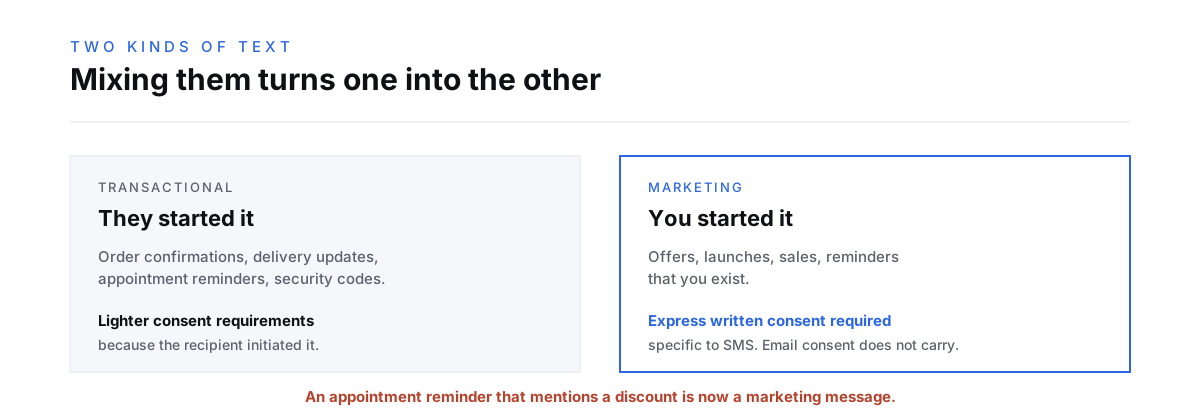
Transactional messages relate to something the recipient already did. Order confirmations, delivery updates, appointment reminders, password codes. These are generally permitted with lighter consent requirements, because the recipient initiated the underlying interaction.
Marketing messages promote something. Offers, launches, sales, reminders that you exist. These require express written consent.
The dangerous move is attaching a promotion to a transactional message. An appointment reminder that also mentions a discount has become a marketing message, and it now needs marketing consent that you may not have. Keep them genuinely separate.
What every marketing message needs
Four things, and none of them are optional.
Identify yourself. The recipient must be able to tell instantly who is texting. An unidentified message from an unknown number is the fastest route to a complaint.
Include opt-out instructions. Usually "Reply STOP to opt out". It does not need to appear in every single message in every jurisdiction, but including it consistently is the safer practice and reduces complaints.
Honor opt-outs immediately and permanently. Once somebody replies STOP, sending again is a straightforward violation. Send one confirmation of the opt-out and nothing further.
Respect quiet hours. Marketing texts should be sent within reasonable daytime hours in the recipient's own time zone. A promotional message at 7am reads as an emergency, and the complaint rate reflects that.
Per message
How penalties are assessed. A single bad send to a few thousand numbers is not a small mistake
What not to do
The list of practices that reliably cause trouble is short and consistent.
Do not buy phone number lists. There is no consent attached, and there is no way to manufacture it retroactively.
Do not assume email consent transfers. These are separate permissions and have to be collected separately.
Do not send from a number that cannot receive replies. If somebody cannot reply STOP, you have not provided a working opt-out.
Do not text at unreasonable hours, including when your audience spans time zones. Schedule by the recipient's local time, not yours.
Do not use SMS for volume. The channel's advantage is that it is read. Sending frequently destroys that advantage faster than in any other channel, because the intrusion is greater.
SMS earns attention because it is rare and relevant. Every message that is neither trains people to opt out, and opt-outs in this channel are permanent.
When SMS is genuinely worth it
Not every business needs it, and it works best in a narrow set of situations.
Time-sensitive information. Appointment reminders, delivery windows, anything where an hour matters. This is where SMS is unmatched and where recipients actively want it.
Genuinely short, genuinely urgent offers. A same-day promotion suits the channel. A general newsletter does not.
Audiences that do not use email. Some demographics and trades are far more reachable by text.
As a complement, not a replacement. SMS works best alongside email rather than instead of it, carrying the small number of messages that genuinely cannot wait.
If your messages are not time-sensitive, email will do the job at lower cost, lower risk, and with far more room to say something useful. Email marketing ROI covers why that channel returns what it does, and how often should you email your list sets out cadence. Our approach is described under email and SMS marketing.
What a good marketing text looks like
The constraints of the channel are also the instructions for writing in it.
Say who you are in the first few words. The recipient sees a fragment on a lock screen. If your name is not in it, the message reads as unknown and unwanted before it is opened.
One idea, one action. There is no room for context, and no appetite for it. A text that requires scrolling has misunderstood the medium.
Be specific about the thing. "We have news" wastes the highest-attention channel you have. Name the offer, the date, or the change.
Give a reason it is a text. If the message could have been an email, the recipient notices. Time sensitivity is the justification for using this channel, so the message should make that obvious.
Link to somewhere that works on a phone, because that is the only device it will be opened on. A link to a page that requires pinching and zooming undoes whatever the message achieved.
Keep a plain-text mindset throughout. No formatting, no images, no cleverness that depends on how it renders. The channel's power is that it looks like a message from a person, and every attempt to make it look like marketing reduces that.
Getting consent properly
The mechanics are simple once the principle is clear.
At signup, ask separately for SMS with its own tick box and plain wording: what they will receive, roughly how often, and that message rates may apply. Store the timestamp, the wording, and the source. If you collect numbers in person or on the phone, record the same information.
A keyword opt-in works well for physical locations. Somebody texts a word to your number, which creates consent with an unambiguous record. It is the cleanest mechanism available because the recipient initiated it.
Then, before every send, confirm the list you are sending to consists only of people who opted in to that specific type of message. Most violations are not deliberate. They are a segment built carelessly.
What to do next
Audit where your existing phone numbers came from. If you cannot say when consent was given and what the person agreed to, do not send marketing to that number.
Then set up a proper SMS opt-in with its own tick box, separate from email, and start the list again from people who genuinely chose it. A small clean list is worth considerably more than a large exposed one.
Frequently asked questions
Do I need consent to send marketing text messages? Yes. Marketing SMS requires express written consent, meaning the recipient actively agreed to receive marketing texts specifically. Pre-ticked boxes and consent buried in terms and conditions do not qualify.
Does email consent cover SMS? No. They are separate permissions and must be collected separately. Someone who subscribed to your newsletter has not agreed to be texted, even if you hold their number.
What is the difference between transactional and marketing texts? Transactional messages relate to something the recipient already did, such as an order or appointment. Marketing messages promote something and require express written consent. Adding a promotion to a transactional message makes it a marketing message.
How quickly must I honor an opt-out? Immediately. Once somebody replies STOP, send a single confirmation and nothing further. Continuing to send after an opt-out is a clear violation.
Can I buy a list of phone numbers? No. Purchased numbers carry no consent, and consent cannot be created retroactively. This is among the most reliable ways to incur penalties, which are assessed per message.
How often should I send marketing texts? Far less often than email. SMS works because it is rare and relevant, so frequent sending destroys the channel's advantage and drives permanent opt-outs. Reserve it for genuinely time-sensitive messages.

Written by
Nick Kvistad
Principal Strategist
Put this to work
Reading about it is free. So is finding out what it would take for your business.
Tell us what you are building and we will tell you honestly what it needs, whether or not you hire us. 85% of our business comes from referrals, because the advice is worth passing on.