Why Your Ads Get Clicks but No Customers
Clicks without conversions is a diagnosis, not a mystery. There are five causes and they can be checked in order.
In short
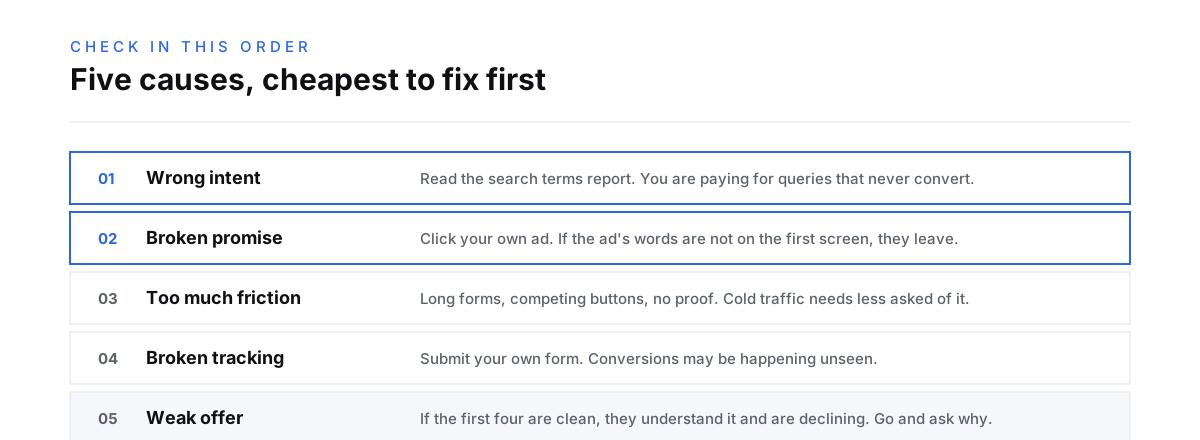
Clicks without customers almost always comes down to one of five things: the wrong intent, a broken promise, a page that asks too much, a tracking problem, or an offer nobody wants.
They are worth checking in that order, because the first two account for most cases and are the cheapest to fix. The temptation is to start adjusting bids. Bids are rarely the problem when clicks are arriving and conversions are not.
One: you are buying the wrong intent
The most common cause, and the easiest to verify.
Open the search terms report, not the keyword list. It shows what people actually typed, and it is routinely nothing like what you thought you were bidding on. Businesses discover they are paying for people looking for jobs, for free versions, for DIY instructions, or for competitors by name.
Broad match makes this worse. A keyword like "brand design" can pick up "brand design courses", "brand design salary", and "brand design free templates". Every one of those clicks costs the same as a real prospect and none will ever convert.
The fix is a negative keyword list built from the actual search terms, reviewed regularly rather than once. On Meta the equivalent is checking placements and audience breakdowns, where a large share of spend often lands somewhere that never converts.
Two: the page breaks the ad's promise
If the ad says one thing and the page says another, people leave within seconds. This is called message match, and it is violated constantly.
The classic version is an ad for a specific service that lands on the homepage. Someone searching for a particular thing, who clicked an ad about that particular thing, now has to find it again on a page about everything. Most will not.
The test is simple: read your ad, click it, and look at the first screen of the page without scrolling. If the words from the ad do not appear, and the thing promised is not immediately visible, you have found a leak.
Fix it by sending each ad to a page about the thing the ad mentioned. If that page does not exist, that is the work, and it is more valuable than any campaign adjustment.
Three: the page asks for too much, too early
People arriving from an ad are colder than people who found you deliberately. Asking them to commit as if they already trust you loses most of them.
Long forms are the usual culprit. Every field costs completions, and most forms collect things nobody needed at first contact. Ask for what you need to have a conversation, then ask the rest during the conversation.
Unclear next steps do the same damage. If somebody has read the page and is interested, exactly one obvious action should present itself. Three competing buttons of equal weight is a decision, and decisions cause exits.
The other frequent offender is missing reassurance. Cold traffic needs evidence: real work, real names, and some sense of what happens after they inquire. A page that makes claims without proof asks for trust it has not earned.
5 causes
Wrong intent, broken promise, too much friction, broken tracking, weak offer. Check them in that order and stop touching bids
Four: conversions are happening and you cannot see them
Before concluding the campaign failed, confirm you would notice if it succeeded.
Tracking breaks constantly and silently. Tags get removed during a site update, a thank-you page gets renamed, consent banners block the script, or the conversion was never configured. It is genuinely common for a campaign to be working while the dashboard reports nothing.
Check it directly: submit your own form and confirm the conversion registers. Then check whether inquiries are arriving by routes the platform cannot see. Phone calls, direct emails, and people who clicked the ad on Monday and returned via search on Thursday all get credited elsewhere or not at all.
Ask new inquiries how they found you. It is unscientific and it repeatedly surfaces attribution the platforms miss entirely.
Before you conclude a campaign is not working, prove you would be able to tell if it were. A surprising share of "failed" campaigns are reporting failures.
Five: the offer is not compelling
The least comfortable possibility and the one worth reaching last, because it is the hardest to fix and the most often correct when the other four check out.
If the intent is right, the message matches, the page is easy, and tracking works, then people are understanding your offer and declining it. That is information. It usually means the proposition is undifferentiated, the price does not match the perceived value, or the timing is wrong for the audience.
The productive response is not more spend. It is talking to people who did not buy. A handful of honest conversations will tell you more than another month of budget, and the answer frequently has nothing to do with advertising.
The traffic quality problem underneath all five
There is a version of this where nothing is technically broken and the traffic was simply never going to buy.
Cheap clicks are cheap for a reason. Broad audiences, loose placements, and content network inventory all deliver volume at attractive prices, and a meaningful share of it is accidental clicks, idle browsing, or people whose situation has nothing to do with your offering. The dashboard shows healthy traffic. The business sees nothing.
The tell is a bounce rate near total combined with very short time on page. Those visitors did not evaluate you and decline. They arrived, registered that this was not what they wanted, and left before reading anything. No landing page change fixes that, because the page was never the issue.
If that describes your account, tighten before you optimize. Narrow the match types, cut the placements that produce no engagement, and accept a higher cost per click for traffic that has some reason to be there. Paying twice as much for clicks that convert at four times the rate is a straightforward win, and it is counterintuitive enough that plenty of accounts never try it.
The order matters
Work through these in sequence rather than changing several things simultaneously.
Start with the search terms report, because it is free and takes fifteen minutes. Then check message match by clicking your own ads. Then reduce the form and clarify the action. Then verify tracking. Only then question the offer.
Changing everything at once is common and self-defeating. If results improve you will not know which change did it, so you cannot repeat it.
For how to set the budget in the first place, how much should you spend on paid ads sets out the arithmetic, and what is a realistic return on ad spend covers what good looks like. If the same problem affects your organic traffic, why your website looks good and still does not convert is the wider version. Our approach is described under PPC and paid ads.
What to do next
Open the search terms report for the last thirty days and read what people actually typed.
Most businesses find at least one query pattern consuming real budget that was never going to convert. Adding those as negatives is the fastest improvement available in a paid account, and it costs nothing but the fifteen minutes.
Frequently asked questions
Why do my ads get clicks but no conversions? Usually one of five causes: you are bidding on the wrong intent, the landing page does not match the ad's promise, the page asks for too much too early, conversion tracking is broken, or the offer itself is not compelling. Check them in that order.
How do I know if my landing page is the problem? Click your own ad and look at the first screen without scrolling. If the words from the ad are not there and the promised thing is not immediately visible, the page is losing people who arrived interested.
What is a good conversion rate for paid traffic? It varies enormously by industry and offer, but paid traffic typically converts below traffic that found you deliberately, because it is colder. Compare against your own previous performance rather than a published benchmark.
Should I send ads to my homepage? Rarely. A homepage covers everything, so someone who clicked an ad about one specific thing has to search for it again. Send each ad to a page about the thing the ad mentioned.
How many form fields is too many? Every field costs completions. Ask only for what you need to start a conversation, usually a name, a contact method, and a sentence about the inquiry. Everything else can be gathered during the conversation itself.
Could my conversions be happening without being tracked? Yes, and it is common. Tags get removed during site updates, consent banners block scripts, and phone or email inquiries never register. Submit your own form to verify, and ask new inquiries how they found you.

Written by
Nick Kvistad
Principal Strategist
Put this to work
Reading about it is free. So is finding out what it would take for your business.
Tell us what you are building and we will tell you honestly what it needs, whether or not you hire us. 85% of our business comes from referrals, because the advice is worth passing on.