How Long Does SEO Take to Work? A Realistic Timeline
Three to six months for first movement, six to twelve for competitive rankings. What happens in each phase, and what should worry you.
In short
Expect 3 to 6 months for the first meaningful movement and 6 to 12 months to reach competitive first-page positions. A brand new domain adds 2 to 3 months on top, because it has no history for Google to trust yet.
Anyone promising page one in 30 days is either targeting keywords nobody searches or selling you something else.
6 to 12 months
How long a new domain needs before it ranks competitively, no matter how good the work is
Why it takes months and not weeks
Three separate clocks have to run, and they run in sequence.
Google has to find the work. Crawling and indexing a changed page takes days to weeks. On a new site it can take longer, because Google has no reason yet to check back often.
Google has to trust the domain. New domains go through a period, often called the sandbox, where they simply do not rank well regardless of quality. It typically takes 6 to 12 months to clear.
The content has to accumulate signals. Rankings respond to engagement, links, and topical depth. None of those exist on day one.
You can compress the first clock. You cannot compress the other two, and any tactic that claims to is the kind that gets sites penalized.
What actually happens, month by month
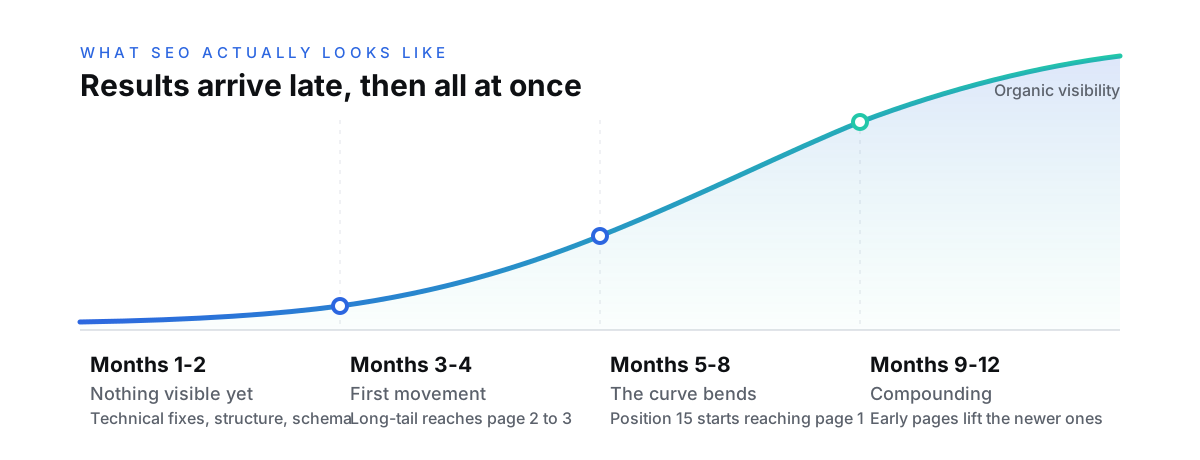
Months 1 to 2: nothing visible, and that is correct. Technical fixes, keyword research, page structure, schema. Impressions may start appearing in Search Console for terms you have never ranked for. Traffic does not move. This phase feels like paying for nothing and it is the phase that decides whether the rest works.
Months 3 to 4: first movement. Long-tail terms start landing on page two or three. Impressions climb faster than clicks. This is the first honest signal that the work is compounding.
Months 5 to 8: the curve bends. Pages that sat at position 15 start reaching page one. Because clickthrough is heavily weighted to the top few results, moving from 11 to 8 produces a bigger traffic jump than the position change suggests.
Months 9 to 12: compounding. Content published in month two is now ranking and passing authority internally to newer pages. This is where SEO stops feeling like a cost.
What changes the timeline
Keyword difficulty is the biggest single factor. Low-difficulty long-tail terms can move in 3 to 6 months. Mid-difficulty terms run 6 to 12. Genuinely competitive head terms take 12 months or more and sometimes never arrive, which is a strategy problem rather than an execution one.
Domain age. A site with existing history and links moves considerably faster than a new one. If you are starting fresh, add 2 to 3 months to every estimate here.
Publishing consistency beats publishing volume. Four solid pieces a month for six months outperforms twenty-four in one week, both for crawl behavior and because complete topic coverage is what earns authority.
Competitive intensity. In a category where every competitor runs an SEO program, you are not climbing a hill, you are climbing past people also climbing.
What should actually worry you
Timelines vary. These do not.
No movement in impressions after 4 months. Clicks lagging is normal. Impressions are the earlier signal, and flat impressions mean pages are not being indexed or not being matched to queries at all.
Traffic that arrives and never converts. Ranking for terms with no buying intent is a common way to produce an impressive-looking report attached to zero revenue.
An agency that will not show you Search Console. You should own the property and see the same numbers they do. Ask before signing.
Any specific ranking promise. Nobody controls Google's index.
A specific position on a specific date is not a service. It is a guess with your money behind it.
What you should be paying while you wait
Budget $1,500 to $3,500 a month for small business SEO, which sits inside the $1,000 to $5,000 the wider market charges (WebFX). Single-location service businesses often start at $1,500 to $2,000. Higher competition or multiple locations runs $2,500 to $3,500.
Budget for at least 6 months, realistically 12. SEO bought in three-month increments almost always gets canceled in month three, one month before the phase where it starts working. If you want to see how that work is structured month to month, our website design and SEO page lays it out.
What to do while the clock runs
The waiting months are only dead time if you spend them waiting. Four things compound while the rankings build, and none of them depends on Google moving first.
Complete your Google Business Profile. For a local business it is the fastest-moving surface in search. Categories, services, photos, hours, and a steady flow of reviews influence the map results on a much shorter clock than organic rankings, and the profile keeps earning while the site climbs. If you serve a defined area, this is where the earliest wins almost always come from.
Collect reviews on a schedule, not on impulse. A short, personal ask after each completed job outperforms an annual blast every time. Reviews compound twice: they move local rankings, and they sit beside your name in the results, deciding clicks before anyone reaches your site at all.
Fix the conversion path before the traffic arrives. SEO earns the visit; the page has to earn the lead. If the site cannot turn a visitor into an inquiry, month nine delivers traffic and nothing else. We have written about why good-looking sites fail to convert, and those fixes cost far less than the traffic you would otherwise waste.
Link your pages as you publish. Every new piece should point at the pages you most want to rank, in plain descriptive language. Internal links are the one authority signal entirely under your control, and sites that build them from the start rank measurably faster than sites that bolt them on at month ten.
None of this is extra credit. It is the difference between arriving at month twelve with rankings, and arriving with rankings, reviews, and a site that converts what they bring in.
How to tell it is working before the traffic arrives
Traffic is the last thing to move, which makes it the worst thing to judge early progress by. Four signals arrive before it, in this order.
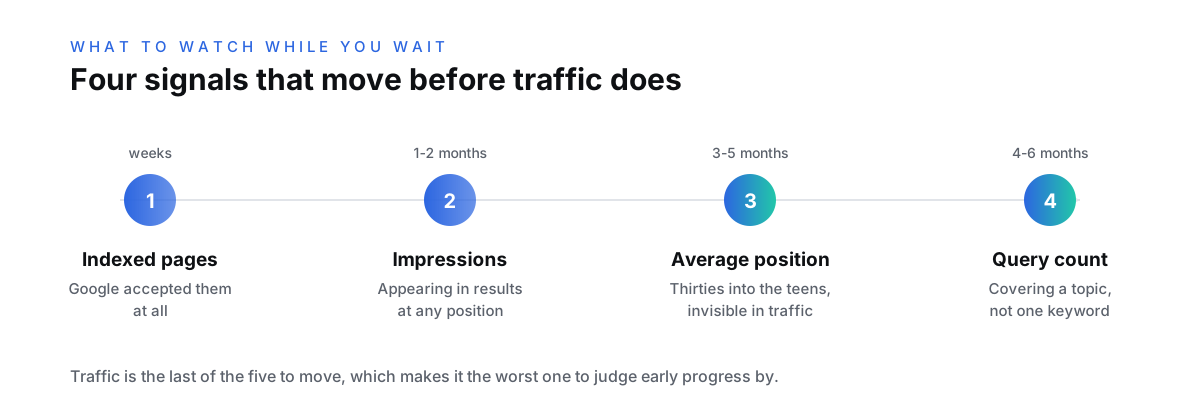
Indexed pages. Search Console tells you how many of your pages Google has actually accepted. If that number is not climbing as you publish, nothing downstream can happen.
Impressions. Your pages appearing in results at all, at any position. This moves in weeks, not months, and it is the first genuine proof that Google understands what your pages are about.
Average position. Watch it fall from the thirties toward the teens. That movement is invisible in traffic because almost nobody clicks past page one, but it is the climb happening.
Query count. The number of distinct searches you appear for. A rising count means you are covering a topic rather than a keyword, which is what earns the authority that makes the next page rank faster.
Ask for these four every month. An agency reporting only on sessions is showing you the one number designed to look flat the longest.
Frequently asked questions
How long does SEO take to work? Most sites see first meaningful ranking movement within 3 to 6 months, and competitive first-page positions take 6 to 12 months. Brand new domains should add 2 to 3 months because they have no established trust with Google.
Why is my SEO not working after 3 months? Three months is usually too early to judge results, but you should already see impressions rising in Search Console even if clicks have not moved. Flat impressions after four months is the real warning sign, and it usually means pages are not indexed or are not matching any query.
Does SEO work faster for a new website? No, it is slower. New domains typically need 6 to 12 months to build enough trust to rank competitively, so add 2 to 3 months to any estimate built for an established site.
How much does SEO cost per month? Small businesses typically pay $1,500 to $3,500 per month. Single-location service businesses start around $1,500 to $2,000, and competitive or multi-location programs run $2,500 to $3,500.
Can I do SEO myself? You can do a meaningful amount, particularly technical basics, Google Business Profile, and consistent content. The parts that get hard are competitive keyword strategy, technical diagnosis, and earning links, which is where most self-run programs stall.
How do I know if my SEO agency is doing anything? Ask for Search Console access under an account you own, then watch impressions and average position, not just traffic. An agency that reports only on traffic and never shows query-level data is showing you the flattering half.

Written by
Nick Kvistad
Principal Strategist
Put this to work
Reading about it is free. So is finding out what it would take for your business.
Tell us what you are building and we will tell you honestly what it needs, whether or not you hire us. 85% of our business comes from referrals, because the advice is worth passing on.