What Does SEO Cost Per Month for a Small Business?
What the market actually charges, what sits inside each tier, and why the cheapest option is usually the most expensive one.
In short
Across the wider market, small business SEO retainers generally run between $1,000 and $5,000 a month, with typical spend centering around $2,500 (WebFX pricing data). Below roughly $1,000 you are usually buying reporting rather than work.
The number matters less than what sits underneath it. Two retainers at the same price routinely buy completely different amounts of work, and the difference is rarely visible until month four.
What follows are market-wide ranges, not our rates. They are here so you can read a proposal properly.
Why the range is so wide
SEO covers at least four separate jobs, and agencies bundle them differently.
Technical work covers how well search engines can crawl, render, and understand your site. Site speed, structured data, internal linking, index management. It is front-loaded: heavy at the start, light once resolved.
Content is the ongoing cost center. Research, writing, editing, publishing, and updating pages. This scales directly with volume and is where most of a retainer goes.
Digital PR and links is the hardest and most expensive part, because it depends on other people agreeing to publish or link to something. It cannot be automated honestly.
Local covers your Google Business Profile, citations, reviews, and location content. Cheap relative to the others and disproportionately effective if you serve a defined area.
An agency quoting $1,200 and one quoting $4,500 may both be telling the truth. They are selling different combinations of those four.
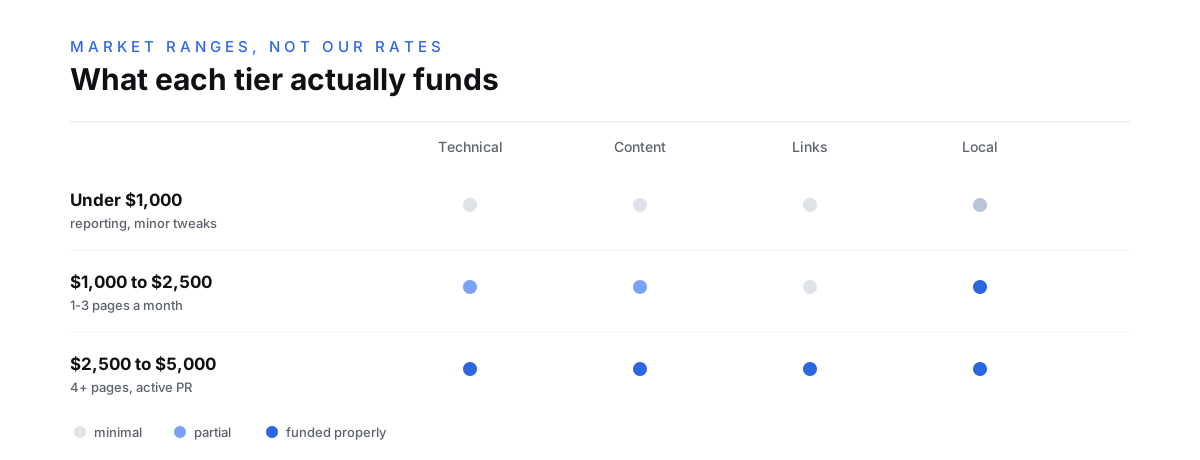
What each tier typically includes
Roughly, and with wide variation by market and agency.
Under $1,000 a month. Usually rank tracking, a monthly report, minor on-page tweaks, and occasionally a thin blog post. There is not enough budget here for content at a useful volume or any link acquisition. This tier suits a business that genuinely only needs someone keeping an eye on things.
$1,000 to $2,500. One to three pieces of real content a month, ongoing technical fixes, local profile management, and light internal linking. Workable for a local business in a market that is not fiercely contested.
$2,500 to $5,000. Four or more substantial pages a month, active technical work, digital PR or link acquisition, conversion improvements, and someone actually thinking about strategy rather than executing a checklist. This is where most competitive small business SEO genuinely sits.
Above $5,000. Multi-location, e-commerce with large catalogs, or genuinely competitive national terms. If you are a single-location service business being quoted this, ask precisely what the extra buys.
4 jobs
Technical, content, links, and local. Every retainer is a different mix of these four, which is why identical prices buy different work
The questions that reveal what you are buying
Price alone tells you nothing. These five questions tell you a great deal.
How many pages will you publish or substantially rewrite each month? A specific number is a good sign. "As needed" means nobody has budgeted the time.
Who writes the content, and do they know my industry? Content is most of the cost. If it is being produced by someone with no subject knowledge and no access to yours, you will pay for pages that rank for nothing.
What is your approach to links? Honest answers involve digital PR, original research, partnerships, and being genuinely worth citing. If the answer involves buying links or private blog networks, walk away. That is a manual action risk you inherit, not them.
What happens in month one that will not happen in month six? Good SEO is front-loaded on technical work and back-loaded on content and authority. An agency that describes an identical month every month is describing a subscription, not a strategy.
What do I keep if we stop? Content, technical fixes, and links are yours. Rankings built on rented links vanish. This question separates durable work from a treadmill.
The cheapest retainer is usually the most expensive one, because six months of reporting with no content or links leaves you exactly where you started, minus the fee.
What actually drives the cost
Three things, in order.
Competition in your market. Ranking for a service term in a small coastal city is a fundamentally different job to ranking in Los Angeles. Same work, different volume required, because you are competing with whoever is already there.
The state of your site. A site with a clean technical foundation and existing content needs less remedial work than one being rebuilt from a template. Some of the first three months is frequently repair rather than progress.
How much content you already have. Businesses with an existing library are adding to an asset. Businesses starting from zero are building one, which takes longer and costs more before it returns anything.
When SEO is the wrong spend
Worth saying plainly, because almost nobody selling SEO will say it: there are situations where this is not your best use of money.
If you need customers this quarter. SEO does not work on that timescale. Anything that moves inside ninety days is either paid, outbound, or an existing relationship. Businesses that buy SEO with an urgent cash need tend to cancel in month three, having paid for the expensive early phase and collected none of the return.
If your site does not convert. Sending more traffic to a page that does not turn visitors into inquiries multiplies a problem rather than solving it. Fix the page first. It is cheaper and the improvement applies to every channel at once.
If nobody is searching for what you sell. Genuinely new categories have no search volume yet, because people cannot search for something they do not know exists. Demand has to be created before it can be captured.
If you cannot sustain it for six months. SEO is close to all fixed cost and delayed return. Three months of budget produces the cost with none of the benefit, which is worse than not starting.
None of that argues against SEO. It argues for sequencing, and for being honest about which problem you are actually solving.
What the first ninety days should look like
The shape of the early work is the same almost everywhere, and knowing it lets you tell progress from activity.
Month one is mostly diagnosis and repair. Technical audit, fixing what is broken, understanding what already ranks. Very little of this is visible externally, which is why month one reports often look thin. That is normal, and an agency publishing content in week one has skipped the diagnosis.
Month two is foundations. Page structure, internal linking, the first content, local profile work if relevant. You may see early movement on low-competition terms.
Month three is volume. Content at a steady cadence, the first link or PR activity, and the beginnings of a trend in Search Console rather than isolated wins.
If by day ninety you cannot see a technical audit, a content plan with actual titles, and pages published on a predictable schedule, the retainer is not being spent on the work.
For how long results actually take to arrive, how long does SEO take to work sets out a realistic timeline. If your traffic is fine and the problem is what happens after people land, why your website looks good and still does not convert is the more useful read.
What to do next
Ask any agency you are considering for the number of pages per month, their link approach, and what changes between month one and month six. Then compare those answers rather than the totals.
If two proposals differ by a factor of three, one of them is either doing far more or charging far more. Those questions tell you which, and they take about ten minutes.
Frequently asked questions
How much does SEO cost per month for a small business? Market rates generally run $1,000 to $5,000 a month per WebFX's pricing data, with typical spend centering around $2,500. Below about $1,000 there is rarely enough budget for meaningful content or link work.
Is cheap SEO worth it? Usually not, because the cost is mostly labor. A very low retainer typically funds reporting and minor tweaks rather than content or authority building, so you pay monthly without accumulating anything durable.
Should I pay monthly or per project for SEO? Monthly suits ongoing content and authority work, which is most of SEO. A one-off project makes sense for a technical audit, a migration, or a site rebuild, where the work has a defined end.
How long before SEO pays for itself? Most businesses see meaningful movement between four and eight months, with compounding returns after that. Budget for at least six months, because stopping at three means paying the full cost and collecting none of the return.
What should be included in an SEO retainer? At minimum: a specific number of content pages per month, ongoing technical work, internal linking, local profile management if you serve an area, and a documented approach to earning links. Reporting is a byproduct, not a deliverable.
Can I do SEO myself instead? You can do a meaningful share of it, particularly local profile management, reviews, and writing content about work you actually understand. The parts that are hard to do alone are technical diagnosis and earning links.

Written by
Nick Kvistad
Principal Strategist
Put this to work
Reading about it is free. So is finding out what it would take for your business.
Tell us what you are building and we will tell you honestly what it needs, whether or not you hire us. 85% of our business comes from referrals, because the advice is worth passing on.