Local SEO in Santa Barbara: What Actually Moves the Map Pack
Proximity, prominence, and relevance decide the local three-pack. Only two of those are things you can change.
In short
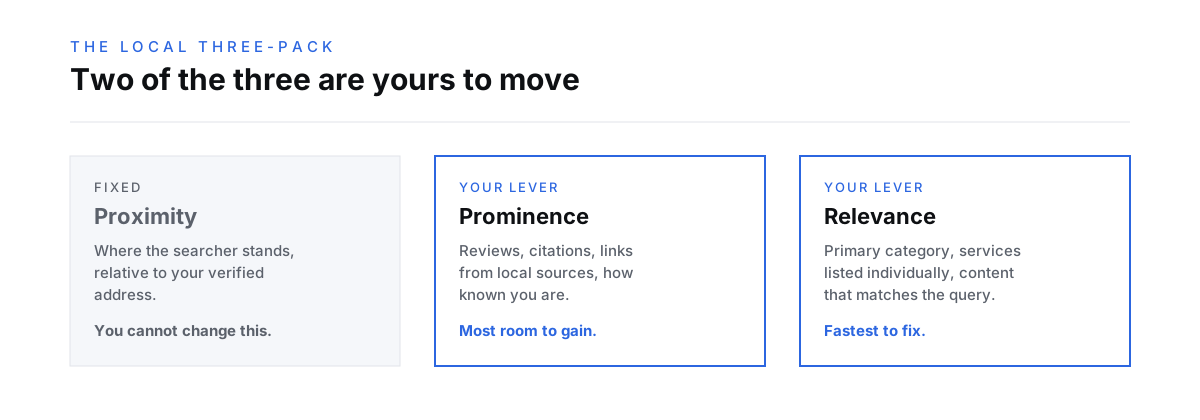
The three businesses in the Google map pack are chosen on proximity, prominence, and relevance. Proximity is where the searcher is standing relative to your verified address, and you cannot change it. The other two you can.
For Santa Barbara specifically, that geography matters more than most places. The city is long and narrow, wedged between the mountains and the ocean, and the commercial districts are strung along that line rather than radiating from a single center. A business on Milpas and one in Goleta are competing in what Google may treat as effectively different local markets.
The three factors, honestly ranked
Google names proximity, prominence, and relevance. It does not weight them equally.
Proximity does most of the work for high-intent searches. Someone searching on State Street gets different results to someone searching in Montecito, for the same query, seconds apart. This is why rank tracking without a location is meaningless locally.
Prominence is how well known your business is, measured mostly through reviews, citations across the web, and links from local sources. This is the lever with the most room in it for most businesses.
Relevance is how well your profile and site match what was searched. Categories, services listed, and content that genuinely addresses the query.
You cannot move your building. So the entire practical game is prominence and relevance.
Your Google Business Profile is the whole foundation
Nothing else works until this is right, and most profiles are half-finished.
A verified address, if you have a real one. A service-area profile with no address pin is at a structural disadvantage for map pack placement, because proximity has nothing to anchor to. If you have premises, list them.
The correct primary category. This single field does more than almost anything else on the profile. "Marketing agency" and "advertising agency" surface for different queries. Pick the one that matches what people search, not the one that sounds most impressive.
Every service listed explicitly. Not a paragraph describing your work. The individual services, named, because they are matched against queries.
Real photographs, added regularly. Interior, exterior, team, work. Profiles with recent photos get more engagement, and engagement feeds prominence.
Hours that are accurate, including holidays. Wrong hours generate the kind of review that is hard to recover from.
Reviews are the prominence lever
Reviews are the most reliable way to move prominence, and the one most businesses handle passively.
Volume matters, recency matters, and so does whether the review text mentions the service and the location. A review saying "great branding work for our Santa Barbara restaurant" is doing considerably more than "5 stars, great job".
You cannot ask for those words directly, and you should not. What you can do is ask at the moment the client is most pleased, make the link one tap, and ask specifically what they found useful. People describing what actually happened tend to name the service naturally.
Respond to all of them, including the negative ones, in public, without defensiveness. Prospective clients read the responses more closely than the reviews.
3 factors
Proximity, prominence, relevance. Only two are within your control, which is where all the effort should go
What Santa Barbara specifically demands
Local SEO advice is mostly written for grid-pattern cities. Santa Barbara is not one.
The geography splits the market. Downtown, the Funk Zone, the Mesa, Goleta, Carpinteria, Montecito, and Summerland behave like distinct search areas. A business downtown may be invisible in Goleta searches despite being fifteen minutes away.
The seasonal swing is real. Tourism reshapes search volume and intent through the year. Hospitality, retail, and anything serving visitors sees genuinely different queries in July than in February.
Several competitors on page one are not local at all. National agencies rank on domain authority without any presence here. They can be outranked on local intent by a business with a real address, real reviews, and content that demonstrates it actually operates here. It is the same case our own Santa Barbara marketing agency page makes.
The economy is not one thing. Wine and hospitality, tech in Goleta, education around the university, agriculture in the valleys, and a substantial professional services layer. Content written for "Santa Barbara businesses" as a single audience tends to land with none of them.
Being genuinely local is a durable advantage against national competitors, but only if the site provides evidence of it. A city name in a title tag is not evidence.
What is a waste of your time
Keyword stuffing your business name. Adding "Santa Barbara Marketing" to a name that is not legally that is a guidelines violation and a competitor can report it.
Buying citations in bulk. A hundred low-quality directory listings does considerably less than being listed accurately in the few places that matter locally.
Chasing rankings without a location. Your position varies by where the searcher is. A single reported rank is close to meaningless.
Building city pages for every nearby town when you have no genuine presence or clients there. That is the doorway pattern, and it is a risk rather than an opportunity.
How to measure local properly
Most local reporting is measuring the wrong thing, which is how businesses conclude local SEO does not work when it is working fine.
Stop tracking a single rank. Your position genuinely differs across the city, so one number is an average of incompatible results. Track position from several specific points instead, or accept that rank is a weak signal locally and use something better.
Use the profile's own data. Google Business Profile reports how many people found you through discovery searches versus searching your name directly. Discovery growth is the number that shows local SEO working. Direct searches mostly reflect people who already knew you.
Count actions, not impressions. Calls, direction requests, and website clicks from the profile are the closest thing to a real outcome. Direction requests in particular are hard to fake and strongly correlate with intent.
Watch the review curve, not the total. A steady trickle beats a burst. Twenty reviews arriving over six months signals an operating business; twenty arriving in a week signals something else, to Google as well as to readers.
Give it a fair window. Profile changes can move within weeks, but review accumulation and local authority are three to six month effects. Judging at day thirty tells you nothing.
If you do not have an address pin yet
A surprising number of profiles are set up as service-area businesses with no verified street address, often because the owner works from home or did not want the address public.
This is a structural disadvantage for map pack placement, because proximity has nothing to anchor to. Adding a verified address usually triggers re-verification by mail, video, or phone, which can take days or weeks. The address does not display publicly until it clears, so the clock on any improvement starts at verification rather than at the moment you save the field.
If you are in that position, it is worth starting the process before investing heavily in the rest, because prominence and relevance work compounds much harder once proximity has something to attach to.
If you want the wider timeline for any of this, how long does SEO take to work covers what to expect month by month, and what SEO costs per month explains where local work sits in a typical budget. Our approach is described under website design and SEO.
What to do next
Open your Google Business Profile and check three things: that the primary category is the one people actually search, that every service is listed individually, and that you have added a photo in the last month.
Then set up a simple routine for asking satisfied clients for a review at the moment they are most pleased. Those two actions move prominence more reliably than anything else available to a local business.
Frequently asked questions
How do I rank in the Google map pack in Santa Barbara? Focus on prominence and relevance, since proximity is fixed. That means a complete verified Google Business Profile with the right primary category, every service listed, steady recent reviews, and site content that demonstrates genuine local operation.
Why does my business rank differently depending on where I search from? Because proximity is a major local ranking factor. Google returns results relative to the searcher's location, so your position legitimately changes across the city. Rank tracking without a specified location is not measuring anything stable.
Do I need a physical address for local SEO? It helps substantially. A verified address gives proximity something to anchor to, which is what map pack placement is largely built on. Service-area businesses can still rank, but face a structural disadvantage for map results.
How many Google reviews do I need to compete locally? There is no threshold, but steady recent reviews matter more than a large old total. In most Santa Barbara service categories, a few dozen genuine reviews with regular additions is competitive.
Should I create pages for every town near Santa Barbara? Only where you have genuine presence, clients, or knowledge. Near-identical pages differing by city name are the doorway pattern Google penalizes, and they risk the rest of your site rather than adding to it.
How long does local SEO take to work? Profile improvements can show within weeks, which is faster than most organic SEO. Review accumulation and local authority build over three to six months, and competitive categories take longer.

Written by
Nick Kvistad
Principal Strategist
Put this to work
Reading about it is free. So is finding out what it would take for your business.
Tell us what you are building and we will tell you honestly what it needs, whether or not you hire us. 85% of our business comes from referrals, because the advice is worth passing on.