Google Ads or Meta Ads: Which One First?
One captures demand that already exists. The other creates it. Which you start with depends on whether people are searching for you yet.
In short
Start with Google if people are already searching for what you sell. Start with Meta if they are not.
That is the entire decision, and it turns on one question: does demand for your offering already exist in a form people type into a search box?
A plumber, a dentist, and a commercial roofer all have existing demand. Somebody has a problem and searches for the solution. A new skincare brand, a lifestyle product, or a service nobody knows they need has no such search volume, because people cannot search for something they have not thought of.
The difference in one line
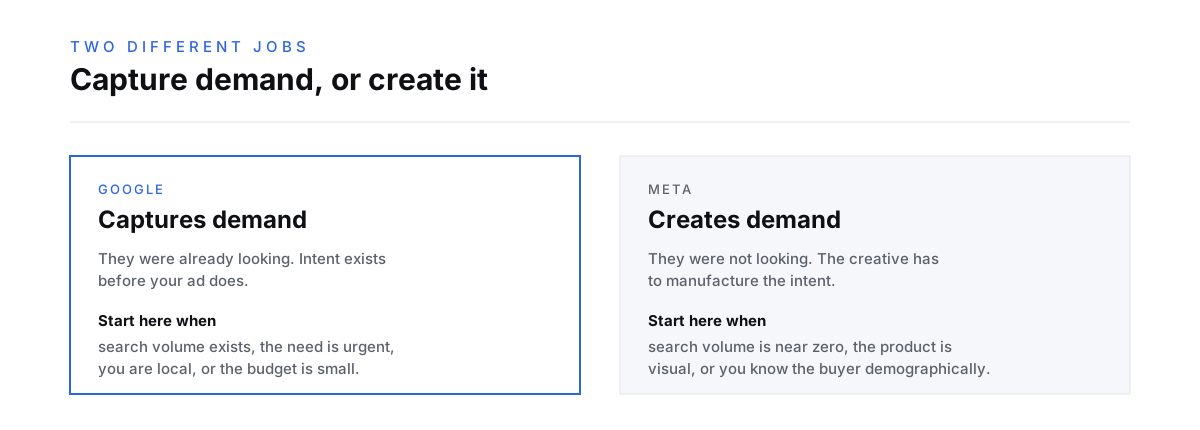
Google captures demand. Meta creates it.
Search ads intercept somebody already looking. The intent is there before your ad is, which is why search traffic converts at higher rates and costs more per click. You are paying a premium to meet somebody at the moment they have decided to act.
Social ads interrupt somebody who was not looking for you. The intent has to be manufactured by the creative, which is why cost per click is lower and conversion rates are too. You are paying less for attention that is worth less, at that moment.
Neither is better. They are different jobs, and running the wrong one first is the most common way a small budget gets wasted.
Start with Google when
People search for your category. Check for yourself: type what you sell into Google's Keyword Planner and look at the monthly volume. If there are hundreds or thousands of searches for the problem you solve, the demand exists.
Your purchase is urgent or problem-triggered. Burst pipes, legal trouble, broken equipment, urgent deadlines. Nobody browses their way into these. They search.
You are local with a defined service area. Local search intent is extraordinarily high quality, and the competition is limited to whoever else serves that area.
Your budget is small. A tight budget goes further against existing demand. Creating demand takes volume and repetition, and both cost money before anything returns.
Start with Meta when
Nobody is searching for your category yet. New products, new categories, or things people did not know were available. Search volume near zero is not a failure of research, it is a signal about which platform to use.
Your product is visual, and seeing it is the pitch. Clothing, interiors, food, physical products, anything where an image does the persuading.
You know exactly who your buyer is demographically. Meta's strength is finding people by characteristics and behavior rather than by stated intent.
You have something worth retargeting with. Even businesses that lead with Google get substantial value from Meta retargeting, because it re-reaches people who arrived through search and did not convert.
One question
Does search volume exist for what you sell? Yes means Google first. No means Meta first. Most platform debates end there
The case for running both, and when it is premature
Most mature programs run both, because they do complementary jobs: Meta builds awareness among people who have never heard of you, and Google catches them later when they search.
But splitting a small budget across two platforms before either is working is the most reliable way to learn nothing from both. Each platform needs enough conversion volume to optimize, and halving an already thin budget usually means neither gets there.
The sensible sequence is to make one platform work first, get it to a return you understand, then add the second. The exception is retargeting, which is cheap, small, and worth running alongside almost anything.
Two half-funded campaigns generate half the data and none of the learning. Pick the platform your demand situation points at, make it work, then expand.
What the first month looks like on each
The two platforms fail differently in month one, and knowing the shape in advance stops you switching off something that was working.
On Google, expect early spend to be inefficient while the account learns which queries convert. The first few weeks are largely about finding and excluding the searches that were never relevant. Costs per conversion typically start high and fall as the negative keyword list grows. If your cost per inquiry in week one horrifies you, that is normal rather than diagnostic.
On Meta, expect the creative to matter more than anything you do with targeting. Most campaigns that fail here fail because the image or video did not stop anyone, not because the audience was wrong. Plan several genuinely different creative concepts rather than minor variations of one, because you are testing ideas, not colors.
Both platforms need enough conversions to optimize properly. Running a campaign that produces four conversions a month and then judging its performance is measuring randomness. If your budget cannot generate meaningful conversion volume on a platform, that is a reason to choose the other one rather than to run both badly.
Give either one at least six to eight weeks before drawing conclusions, and change one thing at a time. Accounts that get restructured weekly never accumulate the data that would tell you what works.
What actually decides success on either
Platform choice matters less than three things underneath it, and all three are within your control.
The offer. What somebody gets, and why it is worth their attention right now. A sharp offer on the wrong platform outperforms a vague offer on the right one.
The landing page. Traffic from either platform lands somewhere, and that page decides whether spend becomes inquiries. It is consistently the highest-leverage thing to fix, and unlike ad platforms it improves every channel at once.
The measurement. If you cannot tell which campaigns produce customers rather than clicks, you cannot improve either platform. Set up conversion tracking before spending, not after.
Businesses regularly switch platforms hoping to fix a problem that lives in one of those three. The new platform then fails in the same way, which at least confirms the diagnosis.
The budget question underneath the platform question
There is a floor below which neither platform can work, and it is worth knowing before you choose.
Paid advertising optimizes by learning from conversions. A campaign generating a couple of conversions a month gives the platform almost nothing to learn from, so it never improves, and it gives you no basis for judging it either. The result is spend without information, which is the worst outcome available.
Work backwards instead of picking a round number. Estimate what a click costs in your category, guess conservatively at how many clicks it takes to produce an inquiry, and multiply out what generating a useful number of inquiries a month would cost. If that figure exceeds what you can commit, the honest answer is that paid ads are not your channel yet, and the money is better spent on the offer, the site, or an organic approach with a longer horizon.
That is a real answer, and considerably cheaper than discovering it across four months of underfunded testing.
What to do next
Search for what you sell in Google's Keyword Planner and look at the monthly volume for your area.
Meaningful volume means start with Google. Near zero means start with Meta and accept that your first job is teaching people the category exists. Then put your effort into the offer and the landing page, because those decide the outcome more than the platform does.
For what return to expect once running, what is a realistic return on ad spend sets out the arithmetic. If traffic is arriving and nothing converts, why your ads get clicks but no customers is the better read. Our approach is described under PPC and paid ads.
Frequently asked questions
Should I start with Google Ads or Facebook Ads? Start with Google if people already search for what you sell, which you can verify in Keyword Planner. Start with Meta if search volume is near zero, because your first job is creating awareness rather than capturing intent.
Which is cheaper, Google Ads or Meta Ads? Meta usually has a lower cost per click, and Google usually has a higher conversion rate. Cost per acquired customer is frequently closer than the click prices suggest, so compare on cost per customer rather than cost per click.
Can I run Google and Meta ads at the same time? Yes, and most established programs do. The caution is budget: splitting a small budget before either platform is working tends to starve both of the conversion volume they need to optimize.
Which platform is better for local businesses? Google, in most cases. Local search intent is high quality and the competition is limited to your service area. Meta is valuable for local awareness and retargeting once search is working.
How much should I spend to test a platform properly? Enough to generate a meaningful number of conversions rather than a fixed amount, which usually means several weeks of consistent spend. Stopping after a handful of conversions measures noise.
Does Meta still work after the iOS privacy changes? Yes, though attribution is less precise than it was. The practical response is to rely more on modeled results and overall business outcomes, and less on exact per-click attribution.

Written by
Nick Kvistad
Principal Strategist
Put this to work
Reading about it is free. So is finding out what it would take for your business.
Tell us what you are building and we will tell you honestly what it needs, whether or not you hire us. 85% of our business comes from referrals, because the advice is worth passing on.