What Is a Realistic Return on Ad Spend for a Small Business?
Most businesses measure ROAS against the wrong number. Here is what good looks like, and the margin that decides it.
In short
The commonly quoted benchmark is 4:1, meaning four dollars back for every dollar spent. It is a reasonable starting assumption and a poor target, because the return you need depends almost entirely on your gross margin.
A business with 70% margins can be profitable at 2:1. A business with 20% margins loses money at 4:1. Same ratio, opposite outcome.
The number that matters is your break-even ROAS, and it takes one line of arithmetic to find.
Work out your break-even first
Divide 1 by your gross margin expressed as a decimal.
At 50% margin: 1 / 0.5 = 2.0. You break even at 2:1, so anything above that is profit.
At 25% margin: 1 / 0.25 = 4.0. The famous 4:1 benchmark is your break-even point, not your success condition.
At 70% margin: 1 / 0.7 = 1.43. You are profitable at less than half the industry rule of thumb.
This is why generic benchmarks cause so much damage. A service business with high margins may switch off campaigns performing perfectly well, because a blog post said 4:1. A product business with thin margins may celebrate 3:1 while quietly losing money on every order.
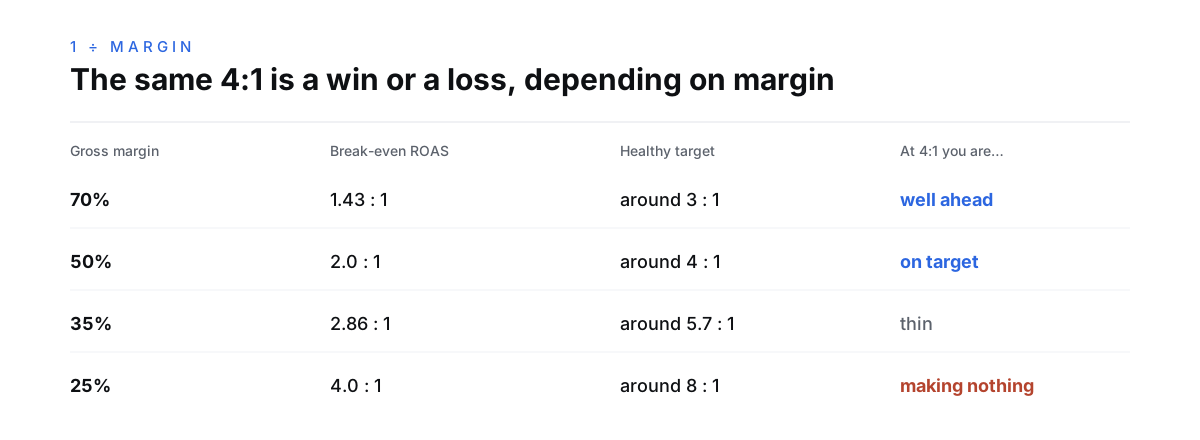
What counts as good, once you know your break-even
Aim for roughly twice your break-even as a healthy target.
That margin of safety covers the things ROAS does not capture: the time someone spends managing campaigns, the platform fees, the returns and refunds, and the fact that attribution is imperfect and some of what you are crediting to ads would have happened anyway.
At 50% margin, break-even is 2:1, so a healthy target is around 4:1. At 25% margin, break-even is 4:1, and you need roughly 8:1 to build a real business on paid acquisition. If that sounds implausible in your category, that is useful information: it means paid ads may not be your primary growth channel, and finding that out through arithmetic is considerably cheaper than finding out through six months of spend.
1 ÷ margin
Your break-even ROAS in one calculation. Every benchmark you read is meaningless until you have compared it to this number
Why first-purchase ROAS misleads
Measuring only the first transaction understates paid ads for any business with repeat custom, and overstates it for any business without.
If a customer typically buys four times over two years, judging acquisition on purchase one is like judging a hire on their first week. The relevant figure is what that customer is worth in total, against what it cost to acquire them.
The opposite trap is just as common. Businesses selling a genuinely one-off purchase sometimes borrow lifetime-value logic that does not apply to them, justify a poor first-purchase return on future value that never arrives, and spend their way into trouble.
So: know which kind of business you are before choosing which number to optimize. Repeat purchase justifies patience on acquisition cost. One-off purchase does not.
ROAS is a ratio, not a verdict. A campaign at 3:1 that brings in customers who buy again is a better business than one at 6:1 that brings in people who never return.
The costs ROAS quietly ignores
Reported ROAS is revenue divided by ad spend. Almost everything else is excluded.
Your time or your agency's fee. A campaign at 3:1 spending $2,000 a month looks different once management cost is included.
Cost of goods and fulfillment. ROAS uses revenue, not profit. This is precisely why margin has to enter the calculation.
Returns and refunds. Reported revenue is usually gross. Categories with high return rates can see real returns land far below the dashboard figure.
Discounts. A campaign leaning on a 20% code is buying revenue at a discount that never appears in the ratio.
Incrementality. Some people who clicked your ad would have found you regardless. Branded search is the worst offender: it reliably reports excellent ROAS while frequently capturing demand you already had.
How to raise ROAS without spending more
Almost every conversation about improving ROAS starts inside the ad platform. Almost every meaningful improvement happens outside it.
Raise the average order or contract value. ROAS is revenue over spend, so anything that increases what a customer is worth improves the ratio without touching a campaign. Bundles, tiers, add-ons, and simply asking for the larger engagement all move this number.
Cut what is spending without converting. Most accounts have a tail of keywords, placements, or audiences consuming budget and producing nothing. Removing them raises the ratio immediately, because the denominator falls while revenue stays put.
Add negative keywords, relentlessly. Search campaigns leak money on queries that were never going to convert. Reviewing the actual search terms report, not the keyword list, is one of the highest-return hours available in a paid account.
Improve the page, not the ad. A landing page that converts at 4% instead of 2% doubles ROAS at identical spend. No bidding change available in any platform does that.
Stop paying for demand you already had. Branded search frequently reports superb ROAS while capturing people who would have found you regardless. Testing what happens when you pause it is uncomfortable and often revealing.
What to do when the numbers do not work
Before concluding that ads do not work for you, check the two things upstream of the ad.
The landing page. Traffic that lands somewhere unconvincing converts poorly regardless of targeting quality. This is usually the cheapest fix available and it improves every other channel simultaneously. Why your website looks good and still does not convert covers the specifics.
The offer. If the thing being advertised is not compelling, no amount of bidding strategy rescues it. Sharpening the offer routinely moves results more than any in-platform change.
Then look at whether you are measuring over a sensible window. Considered purchases have long decision cycles, and a seven-day attribution window on a purchase people think about for a month will systematically understate performance.
If clicks are arriving but nothing converts, why your ads get clicks but no customers works through the causes in order. Our approach is described under PPC and paid ads.
Pick an attribution window that matches your sale
The reporting window quietly decides what your ROAS looks like, and most accounts run whatever default they were given.
If people buy the same day they click, a short window reports reality accurately. If your sale involves two weeks of deliberation, a seven-day window credits none of the conversions that arrive on day nine, and the campaign that generated them looks like a failure.
Match the window to your actual sales cycle, which you can measure: look at how long it typically takes between first contact and a signed engagement. Then hold that window constant. Changing it mid-flight makes every historical comparison meaningless, which is a surprisingly common way businesses convince themselves performance collapsed.
What to do next
Calculate your break-even ROAS today: 1 divided by your gross margin. Write it on something you will see.
Then compare every campaign against that number rather than against a benchmark from an article written for a different business with a different cost structure. Most paid ads decisions get easier the moment that one number exists.
Frequently asked questions
What is a good ROAS for a small business? Roughly twice your break-even, which is 1 divided by your gross margin. At 50% margin that means about 4:1. At 70% margin, 3:1 is already strong. A single universal benchmark cannot account for margin.
Is 4:1 ROAS good? It depends entirely on margin. At 25% margin, 4:1 is exactly break-even and you make nothing. At 60% margin, 4:1 is comfortably profitable. The ratio alone does not tell you.
What is the difference between ROAS and ROI? ROAS compares revenue to ad spend only. ROI accounts for all costs including goods, fulfillment, and management fees. ROAS can look strong while ROI is negative, which is the most common way paid ads lose money quietly.
Why is my ROAS high but my profit low? Usually because ROAS uses revenue rather than profit, and excludes management fees, returns, discounts, and cost of goods. It is also common for branded search to inflate reported ROAS by capturing demand you already had.
How long before I can judge a paid campaign? Most campaigns need enough conversions to be statistically meaningful rather than a fixed period, which usually means several weeks. Judging on a handful of conversions is measuring noise.
Should I include lifetime value in my ROAS target? Only if you genuinely have repeat purchase data. Using projected lifetime value to justify poor first-purchase returns is reasonable for subscription and repeat categories, and a common way to overspend in one-off purchase categories.

Written by
Nick Kvistad
Principal Strategist
Put this to work
Reading about it is free. So is finding out what it would take for your business.
Tell us what you are building and we will tell you honestly what it needs, whether or not you hire us. 85% of our business comes from referrals, because the advice is worth passing on.