How Much Should You Spend on Paid Ads?
Percentage-of-revenue rules are a starting point, not an answer. The real number comes from what a customer is worth to you.
In short
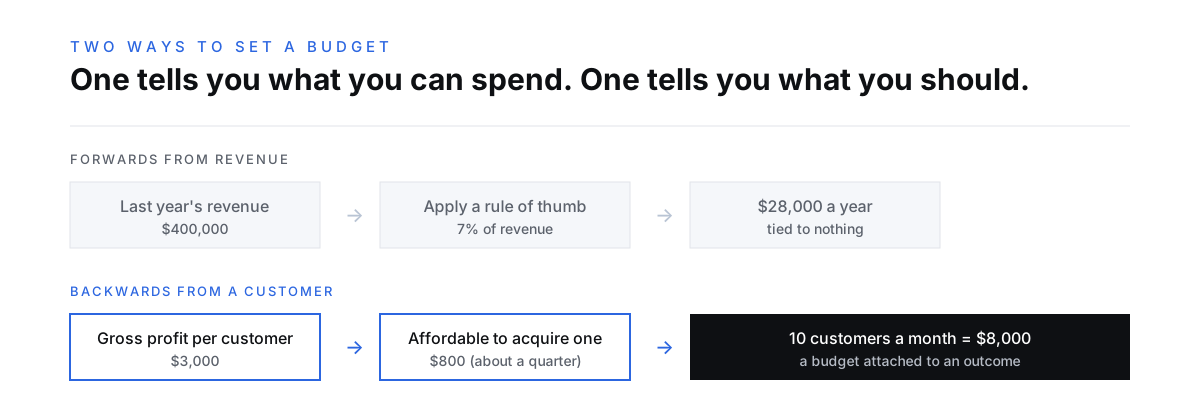
The common rule is 5% to 10% of revenue on marketing overall, with paid ads taking a share of that. It is a reasonable sanity check and a poor way to set a budget, because it works from what you have rather than from what you want.
The better method runs backwards. Decide how many new customers you need, work out what you can afford to pay for one, and multiply. That produces a number tied to an outcome instead of a number tied to last year's revenue.
Work backwards from a customer
Three figures give you a budget, and you probably know two of them already.
What is a customer worth? Not the first invoice. The total gross profit you expect from that relationship, which for most service businesses means the initial engagement plus whatever typically follows.
What can you afford to pay to acquire one? A common working figure is somewhere between a quarter and a third of that gross profit for a healthy business. If a customer generates $3,000 in gross profit, paying $750 to $1,000 to win one is sustainable.
How many do you need? A real number tied to a real goal, not "more".
Multiply the affordable acquisition cost by the number needed and you have a monthly budget with a purpose. Ten new customers at $800 each is $8,000. If that figure is impossible, you have learned something concrete: either the target is unrealistic, the margins do not support paid acquisition, or the channel is wrong.
The floor nobody mentions
There is a minimum below which paid advertising cannot function, and it is the single most common reason small budgets disappoint.
Ad platforms optimize by learning from conversions. A campaign producing two or three conversions a month gives the algorithm almost nothing to learn from and gives you no statistical basis for a decision either. You end up paying for spend without information, which is worse than not running at all.
As a rough gauge, you want enough budget to generate a meaningful number of conversions each month rather than a handful. Work out what a click costs in your category, estimate conservatively how many clicks produce one inquiry, and see what that implies. If the number is beyond reach, the honest conclusion is that paid ads are not your channel right now.
That is a legitimate answer. Discovering it with arithmetic costs nothing. Discovering it across four months of underfunded testing costs four months.
2 numbers
What a customer is worth, and how many you need. Almost every budget question resolves once those two exist
Why percentage rules mislead
Percentage-of-revenue rules describe what established businesses tend to spend. They do not describe what a business needs to spend to grow.
A company holding steady with strong word of mouth might spend 3% and be fine. A company trying to enter a new market might need 15% for a year. Both are correct for their situation, and the average of the two describes neither.
The rules also ignore margin entirely, which is the factor that actually governs what you can afford. A 70% margin business can spend far more aggressively than a 25% margin business at identical revenue, because each customer is worth so much more.
Use the percentage as a sense check after you have done the backwards calculation. If your bottom-up number lands at 40% of revenue, something is wrong with your assumptions. If it lands between 5% and 12%, it is at least plausible.
A budget derived from revenue tells you what you can spend. A budget derived from customer value tells you what you should. Only one of those is connected to whether it works.
Budget for the learning period separately
New campaigns cost more per result than mature ones, always. The first weeks are spent discovering which searches, audiences, and creative actually convert, and much of that spend buys information rather than customers.
Plan for this explicitly instead of being surprised by it. Assume the first six to eight weeks run at a worse cost per acquisition than your target, and make sure your budget survives that period. Businesses that set a budget assuming month-one efficiency almost always switch off in week three, right before the account becomes useful.
The corollary matters too: do not judge a campaign on its opening two weeks. You are looking at the most expensive, least optimized version of it that will ever exist.
Where the money is better spent first
Before committing to a monthly ad budget, check whether something upstream deserves it more.
If your landing page converts poorly, fixing it multiplies the return on every dollar you subsequently spend on ads, and improves organic and referral traffic at the same time. It is almost always the higher-return investment. Why your website looks good and still does not convert covers the diagnosis.
If you cannot measure conversions, spending on ads is spending blind. Tracking first, budget second.
If the offer is not sharp, no budget rescues it. Advertising an unconvincing proposition just distributes the unconvincing proposition faster.
If nobody searches for your category, the platform choice matters more than the amount. Google Ads or Meta Ads: which one first works through that decision.
Seasonality changes the right number
A flat monthly budget is easy to administer and frequently wrong, because demand is rarely flat.
Most businesses have periods when buying intent is genuinely higher, and spending the same amount in a quiet month as in a busy one means overpaying for indifferent attention half the year. Look at your own inquiry history rather than general advice: the pattern is usually obvious once plotted, and it is often not the pattern people assume.
Weight the budget towards the periods when people actually buy. For businesses serving a seasonal market, that can mean a swing of double or more between peak and trough. The total across the year stays the same while the return improves, which is the cheapest optimization available.
The exception is any category where the research phase happens well before the purchase. There, advertising during the quiet period is often what wins the busy one, and cutting spend in the trough removes you from consideration before the decision is made.
How to scale once it works
When a campaign is profitably acquiring customers, the instinct is to double the budget. Resist it.
Increase spend in steps of roughly 20% to 30% and let performance settle between increases. Large sudden jumps push campaigns into looser targeting to spend the money, and efficiency usually falls. The account needs time to find the next tranche of qualified audience.
Watch cost per acquisition rather than volume as you scale. There is a point in every channel where the next customer costs more than they are worth, and the discipline is noticing that point rather than pushing through it. Growth that outruns your acquisition economics is not growth.
For what return to expect, what is a realistic return on ad spend sets out the margin arithmetic. Our approach is described under PPC and paid ads.
What to do next
Write down two numbers today: the gross profit a typical customer generates, and how many new customers you want per month.
Take a quarter to a third of the first, multiply by the second, and you have a starting budget that means something. Then sanity check it against revenue. If the two disagree wildly, the assumption that needs examining is usually the customer target, not the budget.
Frequently asked questions
What percentage of revenue should go to advertising? Common guidance is 5% to 10% of revenue on marketing overall, with ads taking a portion. Treat it as a sanity check rather than a method, because it ignores margin and says nothing about what you are trying to achieve.
How much should a small business spend on Google Ads per month? Enough to generate a meaningful number of conversions rather than a fixed sum. Work it out from what you can afford per customer multiplied by how many you need, then check that it clears the volume floor the platform needs to optimize.
What is a good cost per acquisition? Roughly a quarter to a third of the gross profit a customer generates. Higher than that is sustainable only if customers reliably buy again, and only if you actually have the data to prove they do.
Why is my small ad budget not working? Most likely it is below the volume floor. Campaigns need enough conversions to optimize, and a budget producing two or three a month gives the platform nothing to learn from and you nothing to judge.
Should I increase my budget if ads are profitable? Yes, in increments of 20% to 30%, letting performance settle between increases. Large jumps force looser targeting and usually raise cost per acquisition. Watch acquisition cost rather than volume as you scale.
How long before I should judge an ad campaign? Six to eight weeks in most cases, and longer if conversion volume is low. Early spend buys information rather than customers, so the opening two weeks is the least representative data the campaign will ever produce.

Written by
Nick Kvistad
Principal Strategist
Put this to work
Reading about it is free. So is finding out what it would take for your business.
Tell us what you are building and we will tell you honestly what it needs, whether or not you hire us. 85% of our business comes from referrals, because the advice is worth passing on.