Building a Local Brand With National Ambition
Local credibility is a launchpad, not a ceiling. The mistake is sanding off the specifics that made you worth choosing.
In short
Being local is not a limitation you grow out of. It is the most credible proof you have, and the businesses that scale well are the ones that keep it rather than the ones that hide it.
The common mistake is sanding off every local specific in an attempt to sound bigger. What results is a brand that could belong anywhere, which means it belongs to nobody. Generic is not a bigger version of local. It is a weaker one.
Why local reads as credible
A business rooted somewhere specific is verifiable in a way a placeless one is not.
There is an address, a history, people who have worked with you, a reputation that exists in conversations you are not part of. All of it signals that you are real and accountable, which matters increasingly as the internet fills with businesses that are neither.
Placelessness reads as the opposite. A brand with no stated location, stock photography, and copy about serving clients worldwide gives a prospect nothing to check. Sophisticated buyers notice, and the ones who do not notice consciously still feel it.
So the instinct to look bigger by looking from nowhere is precisely backwards. Specificity is the scarce thing.
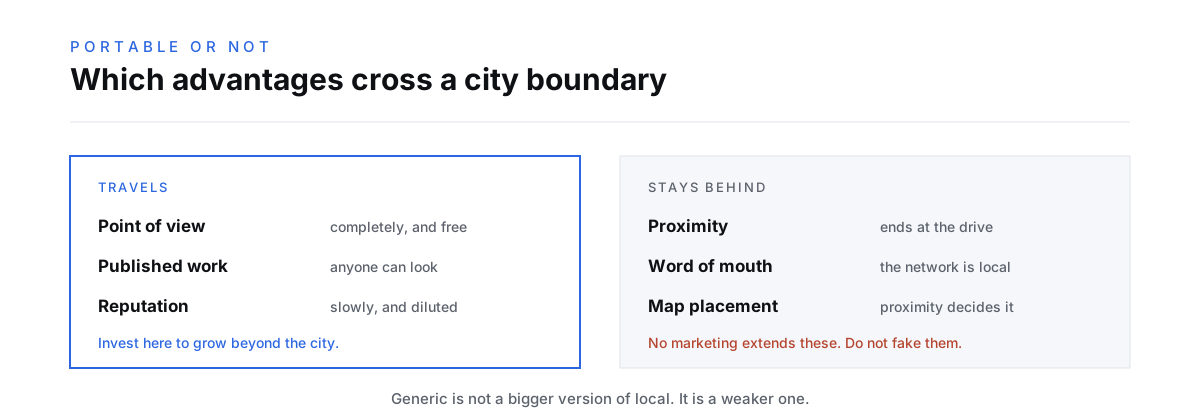
What travels and what does not
Growing beyond your area means being honest about which of your advantages are portable.
Reputation travels, slowly. Reviews, published work, and things written about you are visible everywhere. They do not carry the same weight at distance, but they carry.
Point of view travels completely. What you believe about your field, how you work, the arguments you make publicly. This is the most portable asset you have and the most underused.
Published work travels. Anyone can look at what you have made regardless of where they are.
Proximity does not travel. The advantage of being nearby ends at the edge of a reasonable journey, and no amount of marketing extends it.
Local word of mouth does not travel. The network that generates most referrals is geographically bounded. It does not follow you into a new market, which is why entering one feels like starting again. Because you are.
Local search advantage does not travel. Map pack placement depends on proximity to the searcher. Local SEO in Santa Barbara covers why, and the same logic applies anywhere.
2 of 6
Reputation and point of view are what actually cross a city boundary. Proximity, word of mouth, and map placement stay behind
Own local completely first
The sequencing error is going wide before going deep.
A business that is the obvious choice in its own city has an engine: referrals, repeat work, and a reputation that reduces the cost of every new client. A business that is moderately known in four cities has none of that, and is spending four times the effort to stay moderately known in each.
Depth compounds. Breadth divides. Until you are genuinely difficult to ignore where you are, expansion is mostly a way of making yourself equally ignorable somewhere else.
The test is whether people in your market name you unprompted when the category comes up. If they do not, the work is at home.
Grow through the work, not the map
The mistake most local businesses make when they want to grow is to add locations to their website.
The alternative is to become findable through what you know rather than where you are. Content that answers questions your buyers ask reaches people regardless of geography, and it is the only route that works when you cannot claim proximity. The same material is what AI systems quote when somebody asks a question in your field, and those answers are not filtered by location.
This is slower than adding city pages and it is the version that holds up. It also has a useful property: it attracts people who chose you for your thinking, which tends to produce better clients than people who chose you for being nearby.
A local brand becomes national by being worth finding, not by claiming to be everywhere. The businesses that add ten city pages are competing on presence. The ones that publish real thinking are competing on judgment.
Do not build fake presence
The tempting shortcut is a virtual office, a phone number, and a page claiming a presence you do not have.
It fails on three counts. It is untrue, and prospects who visit discover that. It is against the guidelines of every major local platform, and listings built on it get suspended, which damages the legitimate listing too. And it competes in exactly the arena where you are weakest, since a real operator in that city beats a nominal one every time.
The honest version works better anyway: state clearly where you are, state clearly who you serve, and let the work argue for itself. "Based in Santa Barbara, working with clients across California" is more credible than a fabricated branch office and cannot be undermined by anybody checking. It is close to how we describe our own marketing agency in Santa Barbara.
What actually signals scale
If the goal is to be taken seriously by larger clients, the signals that matter are not geographic.
The quality and depth of published work. More convincing than any claim about reach.
Evidence of thinking. Written points of view, a clear methodology, the ability to explain why you do things a particular way.
Proof of accountability. Named people, real reviews, a real address, clarity about how you work and what happens if something goes wrong.
Selectivity. A small roster described as a deliberate choice reads as confidence. The same roster described apologetically reads as capacity.
None of that requires pretending to be somewhere you are not. All of it is available to a business of any size, which is precisely why it is worth investing in over a map.
When a second location genuinely makes sense
Rarely, and later than most businesses attempt it.
A second location is justified when you have more demand in that market than you can serve remotely, when the work genuinely requires being physically present, and when you can staff it with somebody who will build a real reputation there. All three, not one.
Anything less produces the worst outcome available: the cost of a presence with none of the local advantage, and a diluted brand explaining itself in two places at once.
For how identity supports this, what you actually get in a brand identity system covers the components that make a small operation look considered. For content as the growth mechanism, how much content do you actually need to rank sets out the approach. Our work is in the portfolio, and our approach is described under branding and identity.
What to do next
Look at your homepage and ask whether a stranger could tell where you are and who you serve within five seconds.
If the answer is no because you removed the specifics to sound bigger, put them back. Then put your effort into publishing what you know, because that is the part that crosses a city boundary without you having to claim anything untrue.
Frequently asked questions
Does being a local business limit growth? No, though trying to hide it does. Local roots provide verifiable credibility that placeless businesses cannot match. Growth comes from adding portable assets like published work and point of view, not from removing local specifics.
Should I remove my location from my website to seem bigger? No. A stated location is a trust signal, and removing it makes you harder to verify rather than larger. Stating where you are based and who you serve is more credible than implied ubiquity.
How do I reach clients outside my city? Through content and reputation rather than claimed presence. Material that answers real questions in your field reaches people regardless of geography and is what AI systems cite, neither of which is filtered by location.
Should I create pages for cities I do not operate in? No. Near-identical pages differing only by city name are the doorway pattern search engines penalize, and they compete in the one arena where a genuine local operator will always beat you.
Is a virtual office worth it for local SEO? No. It breaches platform guidelines, risks suspension of your legitimate listing, and is discoverable by prospects. The reputational cost outweighs any ranking benefit, which is usually short-lived anyway.
When should I open a second physical location? When demand in that market exceeds what you can serve remotely, the work genuinely requires being present, and you can staff it with somebody who will build a real local reputation. All three conditions, not one.

Written by
Nick Kvistad
Principal Strategist
Put this to work
Reading about it is free. So is finding out what it would take for your business.
Tell us what you are building and we will tell you honestly what it needs, whether or not you hire us. 85% of our business comes from referrals, because the advice is worth passing on.