Comparing Branding Agencies? The Questions That Separate Strong From Average
Once every agency on your shortlist has a good portfolio, the portfolio stops helping. The difference shows in how they answer a few specific questions.
In short
By the time you have a shortlist, every agency on it has a portfolio you like. That is why they made the list, and it is why the portfolio stops helping you choose.
The difference between a strong agency and an average one shows up in how they answer questions about their thinking, their process, the people doing the work, and what you own at the end. Ask every agency the same questions, in the same order, and write the answers down side by side.
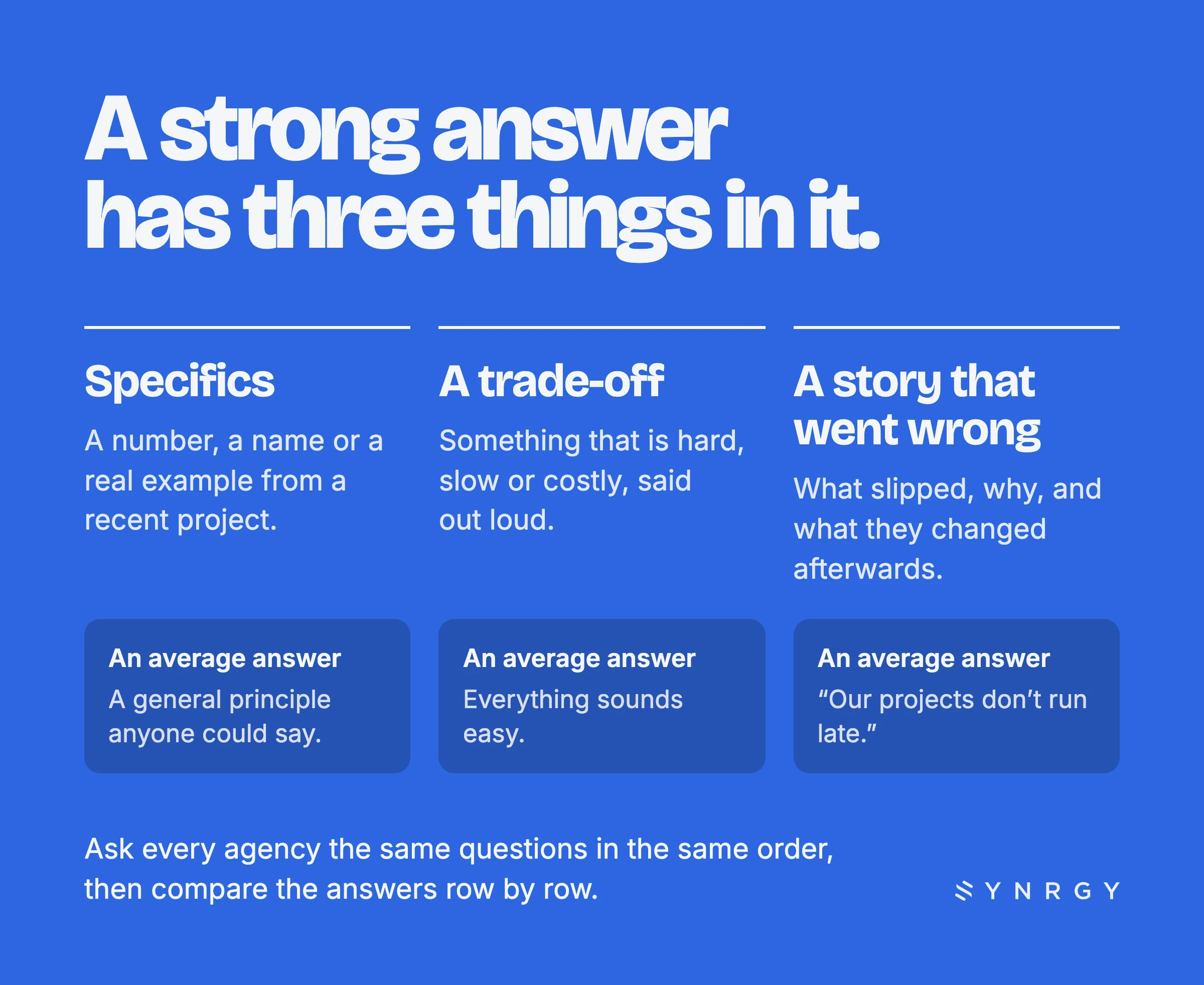
Strong answers are specific. They come with a recent example, they admit a trade-off, and they sound like someone who has run this work many times and watched it go wrong at least once.
Why portfolios stop helping at the shortlist stage
Portfolios show finished work. They do not show how the work got made, how long it took, how many people it frustrated along the way, or whether the client could actually use what they received.
At the shortlist stage you are no longer asking whether an agency can make something good. You have already decided that. You are asking whether this agency can make something good for you, on your schedule, with your decision makers, inside your budget, and leave you with files you can use for years.
That is a process question, and process only shows up when you ask about it directly.
How to run the comparison
Write your questions down before the first call and ask every agency the same ones in the same order. It feels rigid. It is the only way to compare the answers fairly, because a great conversation with one agency can hide that they never answered the thing you needed to know.
Take notes during the call, then fill in a simple grid afterwards: one row per question, one column per agency. Leave a cell empty if the answer was vague. Empty cells are information.
Questions about how they think
"What do you think our real problem is?"
A strong agency will have a hypothesis about your business by the end of the first conversation. It might be that customers do not understand what makes you different, or that the brand looks smaller than the company now is. They should also say what they would need to learn before they were sure.
An average agency answers with a deliverable: a new logo, a refreshed palette, a website. That is a solution looking for a problem.
"What would you tell us not to do?"
This question finds out whether the agency will push back. A strong answer names something specific you mentioned and explains why it might not be worth the money yet. An agency that agrees with everything in the first meeting will agree with everything in the third round of feedback too, and that is how projects drift.
Questions about the process
"Walk me through the last project that ran late. What happened?"
This is the most useful question on the list. Every agency that has done real work has had a project slip. A strong answer is a specific story with a cause, usually something on the client side like a decision maker who joined late, and what they changed afterwards.
An average answer is "our projects don't run late" or a story where the client is entirely to blame. Neither tells you how they handle the moment your project gets difficult, and it will get difficult at least once.
"How many review rounds are included, and what counts as one?"
You want a number and a definition. A round should be one consolidated set of feedback from your side, delivered together. If an agency offers unlimited rounds, ask how they keep projects finishing. Unlimited sounds generous and usually means there are no decision points.
"What do you need from us, and when?"
A strong agency can list it: the people who need to be in the kickoff, the files and logins they will ask for, when they need feedback and how fast. An agency that says "nothing, we handle everything" will discover what it needs from you halfway through, as a delay.
Questions about the people
"Who will actually do the work, and will they be on our calls?"
At larger agencies, the person who pitches is often not the person who designs. That is not automatically a problem, but you should meet the person doing the work before you sign, and that person should be in the review meetings. Feedback that passes through two people before it reaches the designer loses something each time.
"What happens if that person leaves partway through?"
A strong answer describes how the work is documented so someone else could pick it up. An average answer has not considered it. This matters most with very small studios and very large agencies, for opposite reasons.
The best single question on a shortlist call is "tell me about a project that went wrong". An agency with no story has either not run many projects or is not telling you about them.
Questions about what you own at the end
"What exactly do we receive at handover?"
Ask for the list. You should expect the logo system in every format you will realistically use, the type and color specifications, a guidelines document, and the organized, editable source files. If the agency hands over exports only, you will be paying them again every time something needs to change.
"Do we own everything outright, including the source files?"
The contract should say you own the work and can take it elsewhere. If it is vague, assume you cannot. This is worth getting in writing before the project starts, because it is an awkward conversation to have at the end.
"What happens after handover?"
A brand is applied for years after the project ends: to a website, to signage, to the next hire's email signature. A strong agency will tell you what support looks like after launch and what it costs. An average one treats handover as the finish line.
How to compare the answers
Once the grid is filled in, read across each row rather than down each column. You are looking for three things.
Specifics. Did they answer with a number, a name, or a real example, or with a general principle? Principles are easy to say and hard to check.
Honesty about trade-offs. Did they admit anything is hard, slow or expensive? An agency that presents everything as easy is either inexperienced or selling.
Fit with how you work. If you need to involve a board, the agency that asked about your decision makers is a better fit than the one with the stronger portfolio. Process mismatches cost more than small differences in design taste.
If two agencies are still level after this, ask each for a reference you pick from their client list yourself. Then ask that client the late-project question.
Answers that should worry you
"It depends," with nothing after it. It often does depend. A strong agency then tells you what it depends on.
Guaranteed results. Nobody can promise what a brand will do to revenue. An agency that does is willing to say untrue things to close.
Pressure to decide quickly. A discount that expires on Friday is a sales technique. A real scheduling constraint comes with a reason you can check.
No questions back. If an agency spends the whole call presenting and never asks who buys from you and why, they will design for your taste instead of your market.
What to do next
Before your first call, write the questions down, add any that are specific to your situation, and decide who on your side needs to hear the answers. Then run every call the same way.
For the wider evaluation, including how to compare proposals with different prices, see how to choose a branding agency. What branding costs covers the budget side, and how long a rebrand takes covers the schedule.
If you would like to ask us these questions directly, see how we run branding projects and book a call.
Frequently asked questions
What questions should I ask when comparing branding agencies? Ask what they think your real problem is, what they would tell you not to do, what happened on their last late project, how many review rounds are included, who does the work, and exactly what you receive and own at handover. Ask every agency the same questions in the same order so you can compare the answers.
How do I compare branding agencies with similar portfolios? Compare their process instead. Put the answers to the same questions side by side and look for specifics, honesty about trade-offs, and fit with how your business makes decisions. Process mismatches cost more than small differences in design taste.
What is a red flag when interviewing a branding agency? Guaranteed results, pressure to decide quickly, unlimited revisions, vague ownership terms, and an agency that never asks about your customers. Each one suggests the process will be harder than the pitch.
Should I ask a branding agency about projects that went wrong? Yes. It is the most revealing question you can ask. A strong agency tells a specific story and explains what it changed afterwards. An agency that claims nothing has ever gone wrong has either not done much work or is not being straight with you.
Do I own the files when a branding agency finishes? You should, but only the contract decides it. Confirm in writing before the project starts that you own the work outright and receive organized, editable source files, not just exports.
How many branding agencies should be on a shortlist? Two or three is enough to compare properly. More than that and the calls start to blur together, which makes the comparison less reliable.

Written By
Nick Kvistad
Principal Strategist
Put This to Work
Reading about it is free. So is finding out what it would take for your business.
Tell us what you are building and we will tell you honestly what it needs, whether or not you hire us. 85% of our business comes from referrals, because the advice is worth passing on.