How to Choose a Branding Agency Without Getting Burned
The questions that separate an agency with judgment from one selling scope, and the warning signs worth walking away from.
In short
Most branding projects that go wrong were predictable from the first meeting. The warning signs are consistent: a fixed process applied before anyone understood the problem, a portfolio of pretty work with no explanation of what it achieved, and a proposal that prices deliverables instead of outcomes.
The single most useful question you can ask is "what would you need to know before recommending anything?" An agency with judgment will have questions for you. An agency selling scope will already have a package.
Ask what problem they think you have
The best filter takes one meeting. Describe your situation, then ask what they think the actual problem is.
Weak answers restate what you said and attach a service to it. Strong answers push back somewhere. They will suggest the problem might be positioning rather than visuals, or messaging rather than identity, or that you may not need the full project you came in asking for.
That last one matters more than it seems. An agency willing to talk you out of scope is telling you their recommendation is not a function of their invoice. Almost nothing else in the process gives you that signal so cheaply.
Look at their work backwards
Portfolios are curated to be admired. Read them for evidence instead.
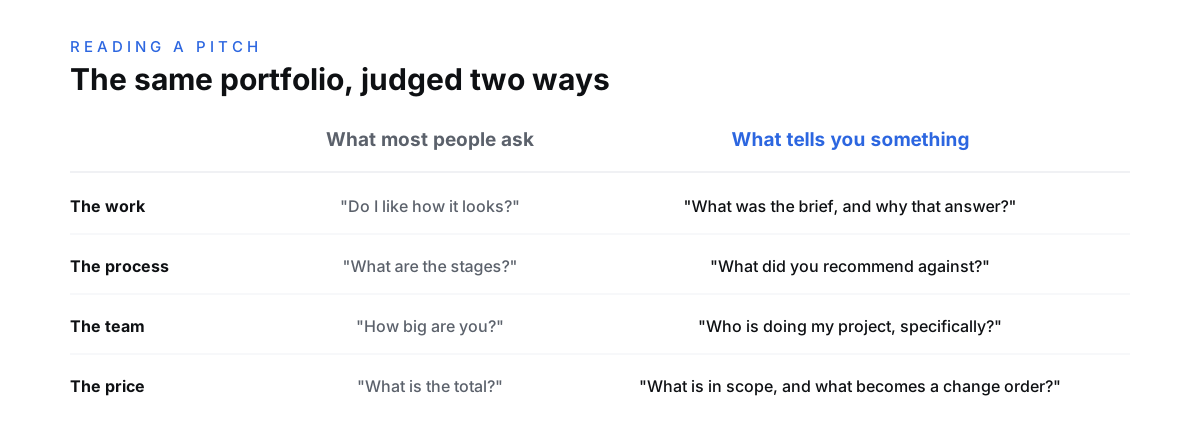
For any piece of work you like, ask what the brief was, what constraints existed, what they recommended against, and what happened afterwards. You are testing whether they can explain the reasoning, because reasoning is the thing you are actually buying. Anyone can show you a nice mark. Far fewer can tell you why it is that shape.
Be wary of a portfolio where every project looks like the same studio made it in the same year. Consistency of craft is good. Consistency of aesthetic across wildly different clients usually means the house style is being applied regardless of fit.
Find out who actually does the work
The people in the pitch are frequently not the people on the project.
Ask directly: who is doing the design, who is writing, who will be in the room for reviews, and how much of their time you get. At a large agency the senior people who won the work often hand it to whoever is free. At a small studio the person pitching is usually the person doing it, which is a genuine advantage and worth asking about explicitly rather than assuming.
There is no correct answer here. There is only the difference between knowing and finding out in month two.
A proposal that cannot tell you who is doing the work is not a proposal. It is an estimate from a company hoping to figure that out after you have signed.
Compare proposals on scope, not on price
Two branding proposals with the same number on them are routinely selling completely different amounts of work. Comparing the numbers alone is meaningless.
Line them up on what is actually included. How many logo variants. Whether a type and color system is in scope or just a mark. Whether photography direction is included. Whether you get written guidelines. How many rounds of revision, and what counts as a round. Whether source files and font licenses transfer to you.
Once those are side by side, the cheaper proposal is often the more expensive one, because everything missing becomes a change order later. For what the market typically charges at each level of scope, what does branding actually cost sets out the ranges.
1 question
"What would you need to know before recommending anything?" separates judgment from a package faster than any portfolio review
The warning signs
None of these are automatically disqualifying. Two or more together usually are.
A recommendation before a diagnosis. If they propose a rebrand before understanding your positioning, they are selling scope.
Unlimited revisions. This sounds generous and signals the opposite. It means the process has no decision points, and projects without decision points do not finish. A defined number of rounds is a sign someone has run this before.
No questions about your customers. An agency that never asks who buys from you and why is designing for your taste, not your market.
Guaranteed results. Nobody can guarantee what a brand will do to revenue. An agency that promises it is either inexperienced or willing to say untrue things to close.
Vague ownership terms. If the contract does not clearly say you own the output and can take it elsewhere, assume you cannot.
Being rushed. Artificial deadlines on a decision this size are a sales technique, not a scheduling reality.
Ask for a reference you chose
Every agency will give you references. The useful move is asking for one you picked yourself.
Look at their portfolio, choose a project they did not put forward, and ask to speak to that client. An agency confident in its work will arrange it. Hesitation tells you the showcased references are curated more carefully than the rest.
When you get the call, skip "were you happy". Ask what surprised them, what took longer than expected, what they would scope differently, and how disagreements got resolved. Every project has friction. You are not testing whether friction existed, you are testing how it was handled, because that is the part you will experience.
Ask one more thing: what happened after the project ended. Plenty of identities look excellent at handover and are unusable within six months because nothing was built to sustain them.
What the first two weeks should look like
You can tell a great deal from how a project opens, and by then you are already committed, so it is worth knowing what good looks like in advance.
The first two weeks should be mostly questions. Interviews with you, conversations with your customers or sales team, a look at how competitors position themselves, and an honest reckoning with what is currently working. If design work appears in week one, the design is decorative: it cannot be responding to anything, because nothing has been learned yet.
You should also get a clear picture of how decisions will be made. Who signs off, how feedback is collected, and what happens when internal opinions conflict. Projects rarely fail on craft. They fail because six people gave contradictory feedback and nobody had the authority to choose.
Expect to be told something you did not want to hear during those two weeks. An agency that agrees with everything is managing you, not advising you.
What to check before you sign
Three things, all boring, all worth ten minutes.
Confirm in writing that you own the finished work and can use and modify it without further permission. Confirm what happens to font licenses. And confirm what "one round of revisions" means concretely, because that phrase means very different things at different studios and it is the most common source of mid-project friction.
If you want a sense of how we scope and sequence this kind of work, our branding and identity service describes it, and our work shows the output. If you are still deciding whether you need a full project at all, rebrand or refresh is the better place to start.
What to do next
Talk to three agencies and ask all of them the same first question: what do you think my actual problem is?
You will learn more from the differences in those three answers than from any amount of portfolio browsing. Then pick the one whose reasoning you would trust when you disagree with them, because at some point in the project you will.
Frequently asked questions
What questions should I ask a branding agency before hiring them? Ask what problem they think you have, who specifically will do the work, what they would recommend against, what is and is not included in scope, and whether you own the finished files. The first question tells you the most.
How do I compare branding proposals with different prices? Compare scope line by line rather than totals: number of logo variants, whether type and color systems are included, photography direction, written guidelines, revision rounds, and file and license ownership. Equal prices frequently buy very different amounts of work.
Is a small studio or a large agency better for branding? Neither is inherently better, but they fail differently. Large agencies risk handing your project to junior staff after a senior pitch. Small studios risk limited capacity. Ask who is doing the work either way.
What are the warning signs of a bad branding agency? Recommending a solution before diagnosing the problem, unlimited revisions, no questions about your customers, guaranteed business results, unclear ownership terms, and pressure to sign quickly.
Should a branding agency guarantee results? No, and be cautious of one that does. Brand affects revenue through too many intermediate steps to guarantee honestly. What an agency can commit to is scope, process, timeline, and the reasoning behind recommendations.
How long should a branding project take? Most complete identity projects run six to twelve weeks. Anything promising a full brand in a week is selling a logo, and anything running past six months has usually lost its decision-making structure.

Written by
Nick Kvistad
Principal Strategist
Put this to work
Reading about it is free. So is finding out what it would take for your business.
Tell us what you are building and we will tell you honestly what it needs, whether or not you hire us. 85% of our business comes from referrals, because the advice is worth passing on.