Branding or Marketing: Which Do You Need First?
They fix different failures. Spending on traffic while your brand confuses people is the expensive mistake. Here is how to tell which problem you have.
In short
Marketing gets people to you. Branding decides what they think when they arrive. They fix different failures, and buying the wrong one is how businesses spend a year getting nowhere while doing everything right.
The diagnostic is simple. If nobody is arriving, that is a marketing problem. If people arrive and leave without understanding what you do or why you cost what you cost, that is a brand problem, and more traffic makes it more expensive rather than less.
Most businesses have one of each. The mistake is buying only the louder one.
The difference that actually matters
Marketing is everything that puts you in front of someone: search, ads, email, content, the work of being findable.
Branding is what happens in the four seconds after. What you appear to be, who you appear to be for, and whether you look like the safe choice or the cheap one.
You can be excellent at one and invisible because of the other. A business with a sharp brand and no marketing is a well-dressed person in an empty room. A business with heavy marketing and a confused brand is paying to send people to a page that talks them out of it.
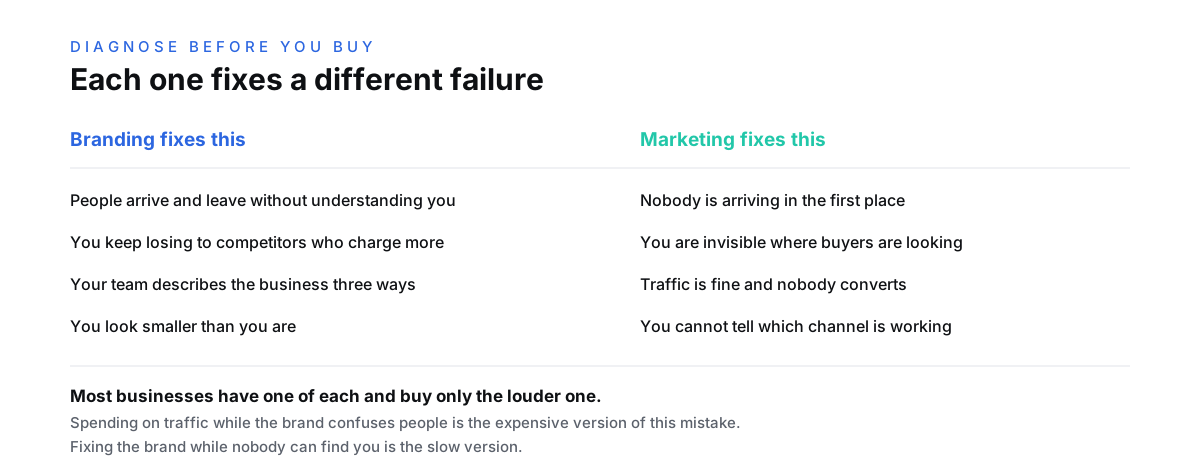
A four question diagnostic
Answer these about the last ninety days.
Are people finding you at all? Check whether anyone is arriving from search, referral, or social. If the honest answer is almost nobody, no amount of brand work changes your revenue this quarter. Start with visibility.
Do people arrive and leave quickly? Traffic that lands and bounces is not a traffic problem. Something on arrival is failing to make the case, and that is usually positioning rather than layout.
Do you lose to competitors who charge more? This is the clearest brand signal there is. Losing on price to someone cheaper is a market position. Losing to someone more expensive means they look like less of a risk than you do.
Can three people in your business describe what you do the same way? Ask them separately. If you get three answers, your customers are getting at least three, and no campaign fixes that because the campaign will also say three things.
Four seconds
Roughly how long a first-time visitor takes to decide whether you look like a serious option, which is less time than any campaign gets to explain itself
What happens if you get the order wrong
Marketing first, brand broken. You pay for attention and convert a fraction of it. The numbers look like a channel problem, so the usual response is to change channel, which costs another quarter and produces the same result. The tell is that every channel underperforms by roughly the same amount.
Brand first, nobody looking. You spend six weeks and real money making the business look like itself, and nothing happens, because the only people who saw it were the ones who already knew you. This is the less expensive mistake, but it is the more discouraging one, and it is why some owners conclude branding does not work.
A confused brand does not reduce your marketing results by a little. It sets the ceiling on every channel at once, which is why fixing the channel never works.
The sequence that usually works
For most small and mid-sized businesses, the answer is not one or the other but a specific order.
Fix the position first, which is the cheap half of branding. Decide who you are for, what you claim, and why someone should choose you. This is a week of thinking, not a project, and it makes everything downstream cheaper because every later decision has a reference point.
Then run the marketing you can afford while the visual system is built. Search and email do not wait for a logo. Our post on building a marketing plan that gets followed covers what to run first when the budget is real.
Then build the identity properly, once, with the position already settled. Building it before the position exists is what produces a brand that looks fine and means nothing.
When branding genuinely comes first
Three cases invert the order.
You are entering a market where everyone looks the same, and looking different is the strategy rather than a decoration on it.
You are raising money or selling into larger companies, where looking established is a qualification round you either pass or never hear about.
You are about to spend heavily on advertising. Sending significant paid traffic to a brand that confuses people is the most expensive version of this whole mistake, because you pay for every visit that arrives at the confusion.
When marketing genuinely comes first
You have a brand that is fine and a pipeline that is empty. Fine is enough. Businesses lose far more to being unknown than to being unremarkable.
You have never measured anything, so you do not yet know which problem you have. Getting measurement in place first is not a delay, it is what turns the next decision from a guess into a decision. Measuring marketing without heavy tracking covers doing this without a large setup.
You are in a referral business where the brand's job is to confirm what somebody already said about you. Confirmation is a lower bar than persuasion.
If you cannot afford both
Most businesses asking this question are not choosing between two full budgets. They are choosing where a limited amount goes, and the honest advice changes when the number is small.
With a modest budget, do not split it. Half a brand project and half a campaign gets you an identity that does not cover your applications and a campaign too short to produce a readable result. Two half-answers cost the same as one whole one and teach you nothing.
Spend it on the position and the single most visible surface. For nearly every business that surface is the website, because it is the one place every channel eventually points and the one asset you keep. A sharp position expressed well on one page beats a full identity system applied nowhere.
Then let the rest arrive as revenue does. Guidelines, secondary applications, print, and the wider system are genuinely deferrable. What is not deferrable is knowing what you claim, because every dollar and hour you spend before that decision is spent twice.
The exception is a business that already converts well and simply needs more people to see it. Put the money into visibility and leave the brand alone. Fixing what is not broken is a satisfying way to spend a budget and a poor way to grow.
One warning about sequencing on a small budget. Whatever you build first has to survive the second step, so avoid decisions that lock you in before the position is settled. A domain you will regret, a name that boxes you into one service, packaging printed in volume: each of those turns a cheap first step into an expensive second one.
What to do next
Run the four questions above and be honest about the answers, particularly the third one. Then buy the thing that fixes the failure you actually have rather than the one that is easier to picture.
If the answer is the brand, here is how we approach branding for Santa Barbara businesses. If the answer is visibility and sequencing, marketing strategy is the other half of the same conversation.
Frequently asked questions
Should a new business do branding or marketing first? Position first, marketing second, full identity third. A new business needs to know what it claims before it pays to say it, but it does not need a complete visual system before it can start being findable.
Can I do marketing without a brand? Yes, and plenty of businesses do it profitably. It costs more per customer, because every campaign is doing explanation work a brand would have done for free, and the gap widens as you spend more.
Is branding worth it for a small local business? It is worth it when you are losing work to competitors who charge more, or when your customers cannot explain what you do. It is not worth it when nobody has heard of you yet, because the first problem to solve then is being found.
How do I know if my brand is the problem? Look for traffic that arrives and leaves, losses to more expensive competitors, and a team that describes the business three different ways. Those three together are a brand problem, not a marketing one.
Do I need to rebrand or just tighten the messaging? Often just the messaging, which is faster and cheaper than a visual rebuild. Rebrand or refresh walks through how to tell the difference before you commit to either.
What does branding cost compared to marketing? Branding is a one-time project with a defined end. Marketing is an ongoing cost that continues as long as you want the results. What branding costs covers the ranges and what moves them.

Written by
Nick Kvistad
Principal Strategist
Put this to work
Reading about it is free. So is finding out what it would take for your business.
Tell us what you are building and we will tell you honestly what it needs, whether or not you hire us. 85% of our business comes from referrals, because the advice is worth passing on.