Retainer or Project: Which Agency Model Fits You?
Projects buy a finished thing. Retainers buy ongoing capacity. Choosing the wrong one is how both sides end up frustrated.
In short
A project buys a defined outcome with an end. A retainer buys ongoing capacity with a rhythm.
Choose a project when the work has a natural finish: a website, an identity, a campaign. Choose a retainer when the work is continuous and the value comes from accumulation: content, SEO, paid media, email.
Most frustration on both sides comes from buying one and needing the other. Retainers with no defined output drift into vagueness. Projects covering work that never finishes end in a series of awkward change orders.
What a project is good at
Projects suit work with a clear shape.
You know roughly what you want, the scope can be described in advance, and there is a recognizable moment when it is done. Websites, brand identities, photography, a specific campaign. Both sides can agree on what finished looks like, which makes the arrangement straightforward to price and easy to judge.
The advantage is definition. You know the cost, you know the deliverable, you can compare proposals, and you can stop afterwards without unwinding anything.
The limitation is that projects handle change badly. Anything not specified becomes a change order, and any work that continues past the finish line has no home. A website launched and then never touched is the usual result, which is how sites quietly decay.
What a retainer is good at
Retainers suit work where value accumulates rather than arrives.
SEO, content, paid media management, email programs. None of these have a finish. They compound, and they need consistent attention rather than a burst of it. A retainer buys that consistency, plus availability: somebody who knows your business well enough to answer a question without a briefing.
The advantage is continuity. Context does not have to be rebuilt every time, and the work gets better as the agency learns your market.
The risk is vagueness. Retainers that do not specify what gets delivered each month drift towards whatever is easiest to justify, which is usually reporting. That is how businesses end up paying monthly for a document nobody reads.
The question that decides it
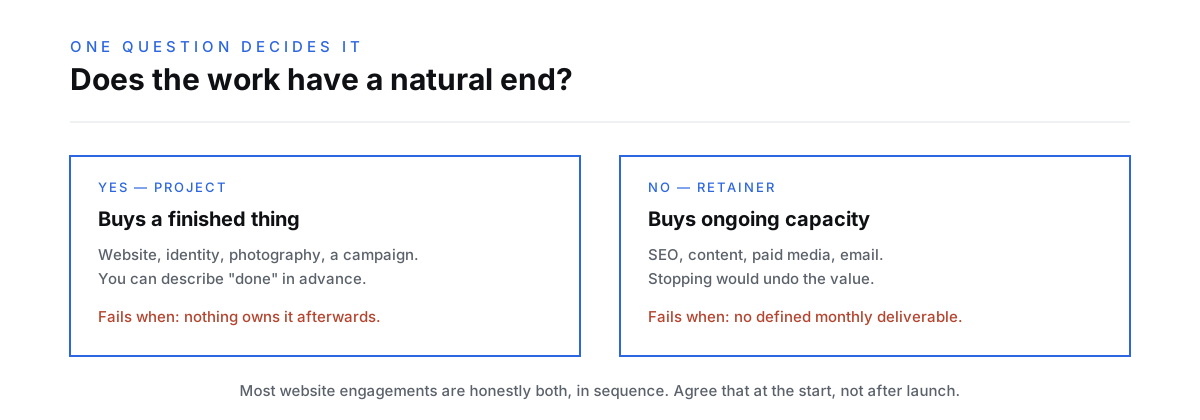
Ask whether the work has a natural end.
If you can describe a finished state and would be satisfied stopping there, it is a project. A new website is finished when it launches. An identity is finished at handover.
If stopping would undo the value, it is a retainer. Stop publishing and rankings decay. Stop managing campaigns and performance drifts. Stop emailing and the list goes cold.
Plenty of engagements are both, in sequence: a project to build the thing, then a retainer to run it. That is usually the honest structure for a website, and it is worth agreeing at the start rather than discovering the gap after launch.
One question
Does the work have a natural end? Yes means project. No means retainer. Almost everything else is detail
How retainers go wrong
Four failure modes, all avoidable, and all worth naming in the agreement.
No defined deliverables. "Ongoing marketing support" is not a scope. There should be a specific monthly output: this many pages, these campaigns managed, this cadence of email.
Hours as the unit. Buying hours makes efficiency your problem rather than theirs, and it rewards slowness. Buying outcomes or defined outputs aligns the incentives properly.
No exit. A retainer with a long lock-in and no break clause removes the pressure that keeps it good. Monthly or quarterly terms after an initial period are reasonable.
Scope that never changes. The right work in month one is rarely the right work in month twelve. Front-loaded technical work should give way to content and authority. A retainer describing an identical month every month is a subscription rather than a strategy.
A retainer without defined deliverables becomes a subscription to reporting. Ask what specifically arrives each month, and expect a number rather than an adjective.
How projects go wrong
Scope defined too loosely. Vague scope means every clarification is a negotiation. Specificity protects both sides.
No plan for afterwards. A website launches and nobody owns it. Six months later it is out of date and nobody agreed whose job that was.
Revision rounds undefined. "One round of revisions" means very different things at different studios, and it is the most common source of mid-project friction. Establish what constitutes a round before starting.
Buying a project because it is cheaper. If the work genuinely continues, a project just defers the cost and adds a gap where nothing happens.
What about hiring instead
The third option gets skipped in most agency comparisons, and it deserves a fair hearing.
An in-house hire makes sense when the work is genuinely full-time, when deep product knowledge matters more than breadth of craft, and when you can manage and develop somebody in a discipline you may not practice yourself. That last condition is the one businesses underestimate. Hiring a marketer when nobody in the company can tell whether their work is good is a common and expensive mistake.
Agencies make sense when you need several skills part-time, which is the usual situation. A small business rarely needs a full-time designer, a full-time writer, a full-time developer, and a full-time paid media specialist. It needs a fraction of each, which is awkward to hire and straightforward to buy.
The hybrid that works well is an in-house person who owns marketing overall, understands the business deeply, and buys specialist craft as needed. That combination tends to outperform either extreme, because somebody internal is accountable while the specialist work is done by people who do it constantly.
Cost comparisons that only weigh a salary against a retainer are misleading. Add recruitment, employment costs, software, management time, and the risk of a single point of failure before deciding which looks cheaper.
Which to start with when unsure
If you are uncertain, start with a project.
A defined piece of work is a low-risk way to find out how an agency actually operates: whether they meet dates, how they handle disagreement, whether the thinking is as good as the pitch. That is worth more than any reference call.
If it goes well, a retainer afterwards begins with the context already built. If it does not, you have a finished deliverable and a natural stopping point rather than a contract to unwind.
The exception is genuinely time-sensitive ongoing work, where waiting to run a trial project costs more than the risk of committing. Even then, agree a short initial term.
For what to ask before signing either, how to choose a branding agency without getting burned covers the questions that reveal how an agency works. For budgeting, marketing budget benchmarks sets out the ranges. Our approach is described under marketing strategy.
What to do next
Write down the work you need and mark each item as either having a natural end or not.
The ones that finish are projects. The ones that would decay if you stopped are retainers. That list is the honest answer, and it usually shows you need both in sequence rather than one or the other.
Frequently asked questions
What is the difference between an agency retainer and a project? A project buys a defined outcome with a clear end, such as a website or identity. A retainer buys ongoing capacity for work that accumulates, such as SEO, content, or campaign management.
Are marketing retainers worth it? For continuous work, yes, because value compounds and context does not have to be rebuilt each time. They are poor value when deliverables are undefined, which is how retainers drift into paying monthly for reporting.
Should a retainer be based on hours? Preferably not. Buying hours makes efficiency your problem and rewards slowness. Buying defined outputs or outcomes aligns incentives and makes the arrangement easier to judge.
How long should I commit to a retainer? An initial period of three to six months is reasonable for work that needs time to show results, followed by monthly or quarterly terms. Long lock-ins remove the pressure that keeps the work good.
Can I start with a project and move to a retainer? Yes, and it is usually the sensible sequence. A project reveals how an agency actually operates, and a retainer afterwards starts with the context already built.
What should a retainer include? Specific monthly deliverables rather than an adjective. A number of content pages, which campaigns are managed, what cadence of email, and how the scope is expected to change between the early and later months.

Written by
Nick Kvistad
Principal Strategist
Put this to work
Reading about it is free. So is finding out what it would take for your business.
Tell us what you are building and we will tell you honestly what it needs, whether or not you hire us. 85% of our business comes from referrals, because the advice is worth passing on.