How to Measure Marketing When You Cannot Track Everything
Attribution is broken and getting worse. Here is how to make confident decisions without pretending you can trace every sale.
In short
Attribution captures less than it used to and less than most dashboards imply. Privacy changes, cookie restrictions, multiple devices, and long decision cycles all mean a meaningful share of your marketing effect is invisible to tracking.
The answer is not better tracking. It is measuring at a level that does not depend on tracing individuals: asking people directly, watching what happens when you change something, and judging trends rather than transactions.
Precision and accuracy are different things. Most marketing reporting offers the first while quietly lacking the second.
Why attribution misses so much
Several forces compound, and none of them are reversing.
Privacy and browser changes. Third-party cookies, tracking prevention, and app privacy controls have removed much of the infrastructure attribution was built on.
Multiple devices. Somebody discovers you on a phone and buys on a laptop. To most systems those are two unrelated people.
Long decision cycles. For considered purchases, weeks pass between first contact and action, well beyond typical attribution windows.
Offline and invisible influence. Recommendations, conversations, a podcast mention, being seen at an event. None of it leaves a trace, and for referral-led businesses it can be most of what actually happens.
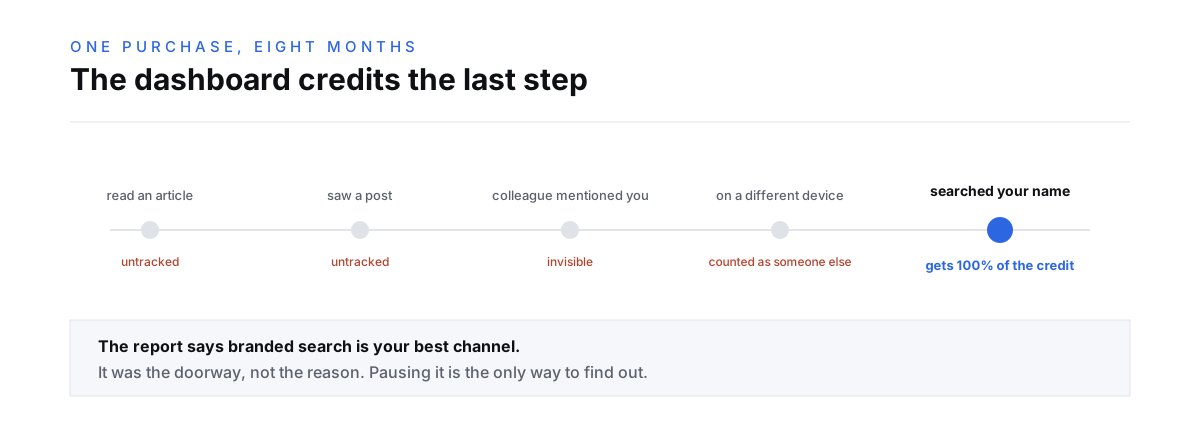
Direct traffic is a black hole. Somebody remembers your name and types it in. That conversion is credited to nothing, when in truth it was created by whatever made them remember.
Just ask people
The most underused measurement tool is a single question on your inquiry form: how did you hear about us?
It is unfashionable because it is not automatic, and it consistently surfaces influence that tracking cannot see. Businesses regularly discover that a substantial share of inquiries mention a channel their analytics reported as producing nothing.
Keep it open text rather than a dropdown. A list constrains people to your assumptions, while free text reveals the referral partner, the community, or the mention you did not know about.
Read the answers monthly rather than aggregating them into a chart. The specifics are the value: "my accountant recommended you" and "I saw your post about pricing" are completely different signals, and both would be flattened into one figure by a dropdown.
One question
"How did you hear about us?" surfaces more genuine influence than most analytics configurations
Test by removing, not by tracking
The most rigorous available answer to "is this working" comes from turning it off.
Pause a channel for a defined period and watch what happens to total inquiries. Not attributed inquiries, total. If nothing changes, the channel was probably capturing demand that existed anyway. If inquiries fall, it was producing something.
This is uncomfortable, and it is the closest a small business gets to a genuine experiment. Branded search is the classic candidate: it reliably reports superb returns while frequently taking credit for people who were always going to find you.
Do it deliberately. Choose a period long enough to see an effect and short enough to survive, avoid seasonal distortions, and change one thing at a time. A month is usually enough for fast-cycle businesses, longer for considered purchases.
Watch the totals, not the parts
When individual attribution is unreliable, aggregate measures become more trustworthy rather than less.
Total inquiries against total marketing spend. Crude, robust, and hard to fool. If spend rose and inquiries did not, something is wrong regardless of what any channel report claims.
Branded search volume. One of the best proxies for whether awareness work is landing. People searching your name learned it somewhere, and a rising trend without a corresponding campaign is a real signal.
Direct traffic trend. Similar logic. It is unattributable by definition, which is exactly why its direction is informative.
Inquiry quality, not just volume. More inquiries from worse-fit prospects is not progress. Track how many reach a proposal, not just how many arrive.
Attribution reports are precise about a fraction of reality. Aggregate measures are approximate about all of it. The second is more useful for deciding what to do.
Accept that some things resist measurement
There is a category of marketing whose effect is real, delayed, and genuinely untraceable, and pretending otherwise leads to bad decisions.
Brand work, reputation, being consistently visible in your field, the article somebody read eight months before they needed you. All of it influences purchases. None of it produces a clean line in a report.
The failure mode is optimizing exclusively for what is measurable, which systematically starves the work that compounds. Businesses that do this often see short-term efficiency improve while the pipeline slowly thins, because they cut the thing that was creating the demand they were efficiently capturing.
Hold some budget for work you believe in but cannot prove, and judge it over years rather than months. That is a defensible position, not an excuse, provided you are honest that it is a judgment call.
Measure the pipeline, not just the top of it
A great deal of measurement effort goes into counting arrivals and almost none into what happens to them, which is where the useful information usually is.
Track how inquiries progress: how many arrive, how many are a genuine fit, how many reach a proposal, how many close. Four numbers, reviewed monthly, and most businesses do not have them.
The value is diagnostic. A channel producing many inquiries that never reach a proposal is producing the wrong inquiries, which is invisible if you only count volume and looks like success on any dashboard. A channel producing few inquiries that almost all close is being underfunded, and it will look like a poor performer next to the first one.
This also catches problems that are not marketing problems at all. If inquiries arrive steadily and stall at the proposal stage, no channel change will help. The issue is the proposal, the pricing, or the follow-up, and spending more on acquisition simply increases the number of people you lose at the same point.
You do not need a system for this. A spreadsheet with four columns, updated monthly, outperforms most analytics setups for actual decision-making.
Build a measurement habit that survives
Simple and consistent beats sophisticated and abandoned.
Monthly: total inquiries, total spend, self-reported source responses read individually, and branded search trend.
Quarterly: what did we learn, what should move, is anything obviously not working.
Occasionally: a deliberate holdout test on one channel.
That is enough for almost any small business. The elaborate dashboard that nobody opens after week three measures nothing, and the effort spent building it would have been better spent reading the inquiry form answers.
For sizing the spend being measured, marketing budget benchmarks covers the ranges, and how to build a marketing plan that actually gets followed covers setting measures in advance. Our approach is described under marketing strategy.
What to do next
Add "How did you hear about us?" as an open text field on your inquiry form today.
Then read the answers yourself for three months. It will tell you more about what is actually working than any analytics configuration, and it costs one form field.
Frequently asked questions
Why has marketing attribution become less reliable? Privacy controls, cookie restrictions, multi-device journeys, and long decision cycles have removed much of the infrastructure attribution depended on. Offline influence such as recommendations was never captured at all.
What is the best way to measure marketing without tracking? Ask people how they heard about you in an open text field, watch aggregate measures like total inquiries against total spend, and occasionally pause a channel to see whether anything changes.
What is a holdout test? Pausing a channel for a defined period and watching total inquiries rather than attributed ones. If nothing changes, the channel was probably capturing existing demand rather than creating it.
Should I use a dropdown for "how did you hear about us"? Open text works better. A dropdown constrains people to your assumptions, while free text reveals referral partners, communities, and mentions you did not know existed.
How do I measure brand marketing? Imperfectly, and mostly through proxies: branded search volume, direct traffic trend, and whether people mention you unprompted. Judge it over years rather than months and accept that some of it will never be traceable.
Is direct traffic really unattributable? Yes, and its trend is still informative. People typing your name learned it somewhere, so a rising direct trend without a campaign usually means awareness work is landing.

Written by
Nick Kvistad
Principal Strategist
Put this to work
Reading about it is free. So is finding out what it would take for your business.
Tell us what you are building and we will tell you honestly what it needs, whether or not you hire us. 85% of our business comes from referrals, because the advice is worth passing on.