Marketing Budget Benchmarks: What Should You Spend?
The published percentages describe averages, not decisions. Here is what the ranges actually mean and when to ignore them.
In short
The common benchmark is 5% to 10% of revenue for established businesses, and 10% to 20% for businesses actively pursuing growth or entering new markets.
Those figures describe what companies do on average. They do not tell you what you should do, because averages combine businesses with completely different margins, growth ambitions, and competitive positions.
Use them as a sanity check on a number you derived some other way, never as the derivation itself.
What moves you up the range
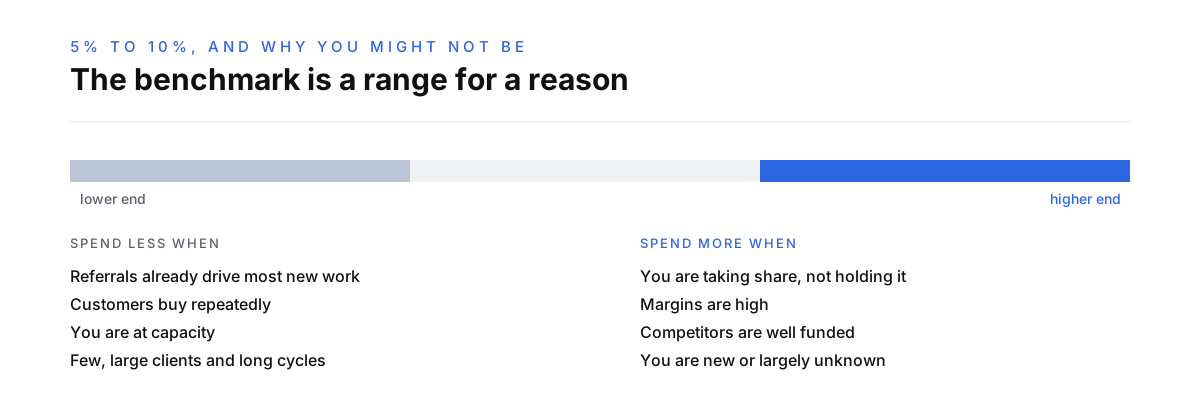
Four factors push a sensible budget towards the higher end, and they compound.
Growth ambition. Holding position costs less than taking share. A business trying to grow substantially is buying attention it does not currently have, and that is more expensive than maintaining attention it already earned.
High margins. A business keeping 70% of every dollar can afford to spend far more acquiring customers than one keeping 25%. Margin is the single most overlooked variable in budget conversations.
Competitive markets. If several well-funded competitors are bidding for the same attention, the price of that attention is set by them rather than by you.
Being new or unknown. Established businesses benefit from reputation and repeat custom that cost nothing to maintain. New businesses have to buy every customer, at least initially.
What moves you down
Strong word of mouth. A business where most new work arrives through referral has an acquisition engine that runs without media spend. Protecting that is usually a better investment than advertising.
Repeat purchase. If customers buy repeatedly, each acquisition is worth more, so fewer are needed, and retention spending outperforms acquisition spending.
Constrained capacity. Generating demand you cannot serve is worse than not generating it. Businesses at capacity should spend on price positioning and selectivity rather than volume.
Long sales cycles with few, large customers. Where five clients constitute a year, mass marketing is usually the wrong instrument. Direct relationships and reputation matter more than reach.
5-10%
The established-business benchmark. Useful only as a check on a number you worked out from your own margins and goals
Split the budget by job, not by channel
Channel-first budgeting produces spending that adds up to no strategy. A more useful split is by what the money is doing.
Foundations, the things everything else depends on. Website, photography, identity, tracking. Typically front-loaded, and underinvesting here makes every subsequent dollar less effective, because you are sending traffic to something that does not convert.
Demand capture, reaching people already looking. Search ads, SEO, local presence. This is the most measurable spend and usually the first thing worth funding once foundations exist.
Demand creation, reaching people who are not looking yet. Social, content, PR, brand work. Slower, harder to attribute, and what makes capture cheaper over time by ensuring people recognize your name when they eventually search.
Retention, keeping and growing existing customers. Email, service, community. Consistently the cheapest growth available and consistently the most underfunded.
A reasonable starting shape for a business with foundations in place is roughly half to capture, a third to creation, and the remainder to retention. Adjust to whichever is most obviously broken.
A budget that funds only demand capture buys customers who were already looking. A budget that funds only demand creation buys awareness with nothing to convert it. Both fail slowly enough to be mistaken for bad luck.
Include the costs people forget
Budgets set on media spend alone are routinely a third short of reality.
Production. Ads need creative, content needs writing, video needs making. This is frequently larger than the media budget and almost always omitted from planning.
Tools. Email platform, analytics, scheduling, hosting, design software. Individually small and collectively significant.
Management. Somebody has to do this work, whether that is your time, an employee's, or an agency's. Time has a cost even when it does not generate an invoice.
The learning period. New channels cost more per result at first. Budget for a period of paying to find out what works, because that period is not optional.
When to ignore the benchmarks entirely
Percentages break down at both extremes and in one important middle case.
Very early businesses have little or no revenue to take a percentage of. Budget from what you can afford and what the goal requires, not from a fraction of a number that barely exists.
Businesses in a step change cannot use a percentage of last year's revenue to fund next year's ambition. A new market or a new product line is an investment decision, not a maintenance calculation.
Businesses whose growth is not marketing-constrained. If the bottleneck is delivery capacity, hiring, or an unfinished product, marketing spend makes the constraint more painful rather than less. Spend it on the constraint.
Work the number bottom-up instead: what a customer is worth, what you can afford to acquire one, and how many you need. How much should you spend on paid ads works through that arithmetic in detail.
What to do when budgets get cut
Marketing is usually first to be reduced when money tightens, and how you cut matters more than how much.
Cut breadth before depth. Running five channels at half strength is worse than running two properly. Reducing across the board produces a portfolio where nothing has enough behind it to work, which then confirms the suspicion that marketing does not work.
Protect the compounding things. Content already published, an email list already built, and search positions already earned keep producing at low cost. Cutting them saves little now and costs disproportionately later, because rebuilding takes far longer than maintaining.
Cut demand creation before demand capture, but not to zero. Capture is more measurable and closer to revenue, so it survives scrutiny better. Just be aware that starving creation entirely means capture gets more expensive over the following year as fewer people recognize you.
Do not cut in a downturn if you have capacity and competitors are cutting. Attention becomes cheaper precisely when everybody withdraws. This is the most reliably profitable contrarian move available in marketing, and the hardest to get approved.
The version to avoid is the silent cut, where budget is not formally reduced but nothing gets commissioned. That produces the cost of a marketing function with none of the output.
Review it quarterly, not annually
Setting a budget once a year and holding it means twelve months of not responding to what you learn.
Reviewing quarterly lets you move money towards what is working and away from what is not, while still giving each channel long enough to show results. Anything reviewed monthly gets cut before it has had a fair run.
The useful question at each review is not "did we spend the budget" but "what did we learn, and what does that change". A budget that never moves has not been managed.
For building the plan the budget funds, how to build a marketing plan that actually gets followed covers it. For measuring the parts that resist attribution, how to measure marketing when you cannot track everything is the companion piece. Our approach is described under marketing strategy.
What to do next
Work out what a customer is worth to you in gross profit and how many more you want this year.
Multiply what you can afford to spend acquiring one by the number you need. Then check that figure against 5% to 10% of revenue. If they broadly agree, you have a defensible budget. If they disagree sharply, the assumption worth examining is usually the customer target rather than the percentage.
Frequently asked questions
What percentage of revenue should a small business spend on marketing? Around 5% to 10% for established businesses, and 10% to 20% for those pursuing significant growth. Treat these as a sanity check on a bottom-up calculation rather than a method in themselves.
How should I divide my marketing budget? By job rather than channel: foundations, demand capture, demand creation, and retention. A common starting shape once foundations exist is roughly half to capture, a third to creation, and the rest to retention.
Does the marketing budget include staff and tools? It should. Budgets set on media spend alone are typically a third short, because they omit production, software, management time, and the learning period a new channel needs.
Should I spend more on marketing when business is slow? Often yes, if the slowdown is demand-related and you have capacity. Cutting marketing in a downturn is common and tends to extend it, since the effects arrive after a delay in both directions.
How often should I review my marketing budget? Quarterly. Annual reviews mean twelve months of not responding to what you learn, while monthly reviews cut channels before they have had a fair run.
What if my calculated budget is more than I can afford? That is useful information rather than a failure. It usually means the customer target is unrealistic, the margins do not support paid acquisition, or you need a slower channel with a longer horizon.

Written by
Nick Kvistad
Principal Strategist
Put this to work
Reading about it is free. So is finding out what it would take for your business.
Tell us what you are building and we will tell you honestly what it needs, whether or not you hire us. 85% of our business comes from referrals, because the advice is worth passing on.