How Much to Budget When Testing a New Ad Channel
A fair test needs enough budget for the platform to finish learning and enough time to see a pattern. Here is how to work out that number before you spend anything.
In short
A channel test needs two things: enough results for the platform's algorithm to learn, and enough time for you to see a pattern instead of a few lucky days. Budget for both, or the test tells you nothing.
The simplest way to work out the number is to multiply the results you need by what you expect each one to cost, then check it against each platform's own minimums and learning rules. Meta, for example, says an ad set usually leaves its learning phase after about 50 results in the week after its last significant edit.
If that number is more than you can afford, the answer is to change the test, not to run a smaller version of it. A test that never finishes learning looks like a channel that does not work.
Why a small test is often a wasted test
Most failed channel tests fail the same way. Someone sets a modest budget, runs it for ten days, sees a high cost per lead, and decides the channel does not work for their business.
Often the channel was never given a fair chance. Ad platforms use the first stretch of a new campaign to explore: trying different people, placements and times to find who responds. Results during that period tend to be less stable, and often more expensive, than they will be later. A budget that runs out during exploration measures the exploration, not the channel.
The opposite mistake is less common and more expensive: spending far more than you need to answer the question. Working out the number in advance prevents both.
Start with what one result is worth
Before any platform numbers, decide what a result is and what you can afford to pay for one.
A result is the action you would count as a win: a lead form submitted, a call booked, a purchase. Pick the one closest to revenue that still happens often enough to measure.
Then work out the most you can pay for it and still make money. If one in four leads becomes a client and a client is worth a known amount of profit, the most you can pay per lead follows directly. What a realistic return on ad spend looks like walks through that arithmetic.
You will also need a guess at what a result will actually cost on the new channel. If you already advertise elsewhere, your current cost per result is a reasonable starting point. Treat it as a guess, and plan to replace it with the real number once the test is running.
What each platform needs to learn
About 50 results
What Meta says an ad set usually needs in the week after its last significant edit to leave the learning phase
Meta (Facebook and Instagram). Meta's help center says an ad set usually exits the learning phase after about 50 results in the week after its last significant edit. If it is unlikely to get about 50 optimization events in that week, Meta marks it "Learning limited", and says that status is not a penalty. Meta also advises waiting to edit an ad set until it is out of the learning phase, because significant edits, such as changes to targeting, creative, the optimization event or the bid strategy, start learning again. If you set a cost per result goal, Meta's guidance is a daily budget of at least five times that goal.
Google Ads. Google's help center says a Smart Bidding strategy's learning status never lasts more than seven days, and that performance typically settles within one to two conversion cycles. It recommends evaluating over two conversion cycles or a two-week window, whichever is longer. For a formal experiment, Google recommends running at least four to six weeks. Target CPA can start with no conversion history, while Target ROAS on Search and Shopping campaigns needs at least 15 conversions in the past 30 days.
LinkedIn. LinkedIn's own advertising site gives a minimum daily budget of $10 and a minimum lifetime budget of $100 for new campaigns. Its help center recommends running an ad set for at least seven days to see results, with an audience of at least 50,000 members. LinkedIn does not publish a number of results needed before you judge a campaign.
How long to run the test
Plan on at least two weeks, and longer if your customers take time to decide.
The platforms' own guidance points the same way. Meta recommends A/B tests of at least seven days. Google recommends judging over two conversion cycles or two weeks, whichever is longer, and four to six weeks for a formal experiment. LinkedIn recommends at least seven days per ad set.
A conversion cycle is how long it usually takes between someone first clicking and actually converting. If your buyers typically take three weeks to fill in a form after their first visit, a two-week test will end before most of its results arrive.
Decide the end date before you start. Tests without an end date tend to be stopped early on a bad week or left running on a good one, and both distort the result.
Working out the number
Put the pieces together in four steps.
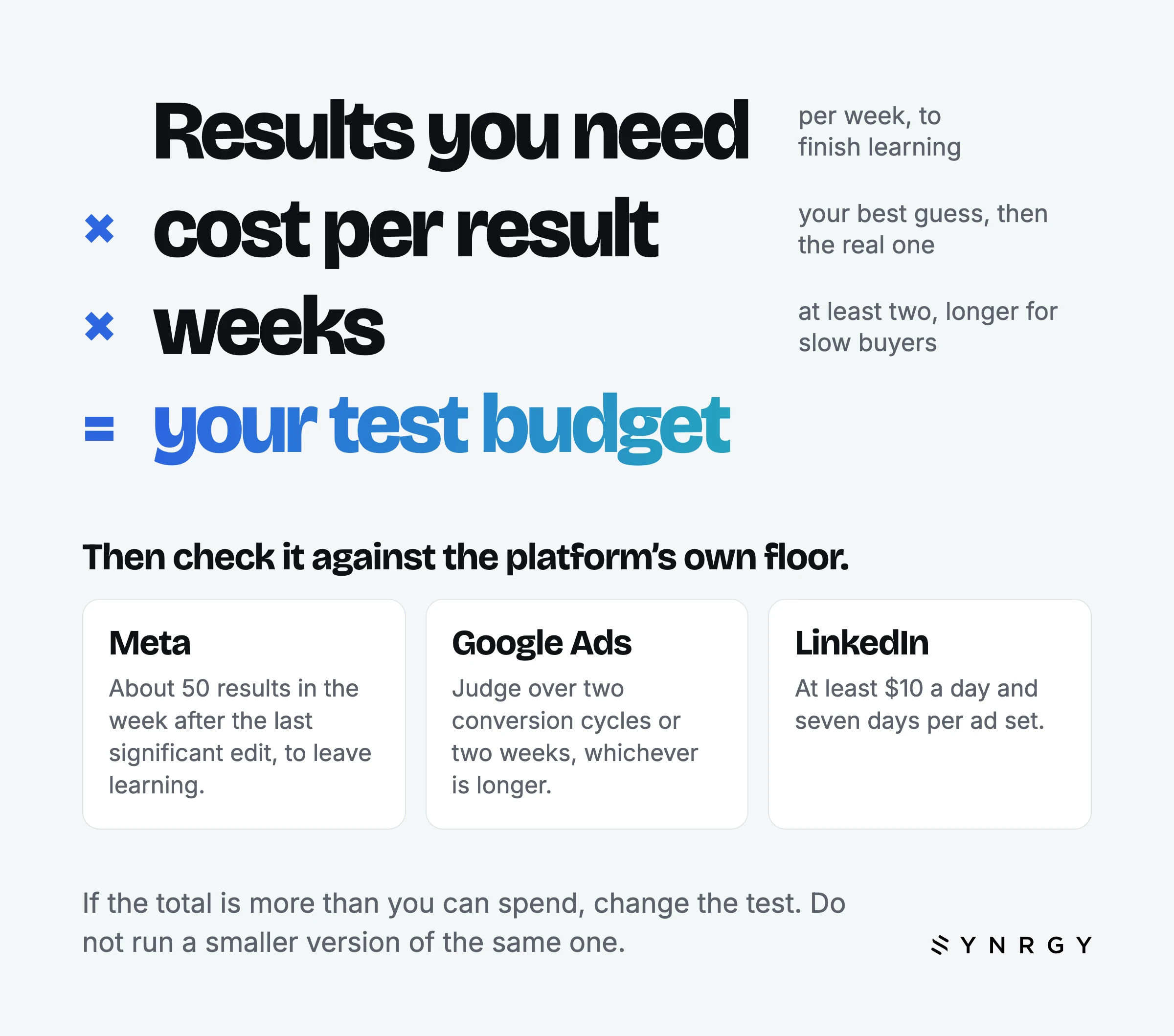
- Decide how many results you need to judge. A sensible floor is the number the platform needs to learn. On Meta, that is about 50 results in a week for each ad set.
- Multiply by your expected cost per result. That gives the weekly budget the test needs to learn properly.
- Multiply by the number of weeks. Use the length you decided above, at least two weeks.
- Check it against the platform's minimums. For example, LinkedIn's $10 a day, or Meta's five-times rule if you use a cost per result goal.
Here is an illustrative example, with made-up numbers to show the arithmetic. Suppose you expect a lead on Meta to cost around $40. Fifty leads in a week would need about $2,000 that week, and a three-week test would need about $6,000. Your own numbers will differ, which is exactly why it is worth doing this before you spend anything.
The "about 50 results a week" figure is Meta's description of when learning usually ends, not a budget recommendation from Meta. Multiplying it by your cost per result is simply the arithmetic of reaching it.
If the honest number is more than you can spend, change the test. A test that is too small to finish learning will look like a channel that does not work.
When the math says you cannot afford a fair test
This happens often, especially with expensive results such as purchases of high-value services. There are better options than shrinking the test.
Optimize for a more frequent action. If 50 purchases a week is out of reach, a lead or a landing-page view happens far more often. You learn less about the final sale, but the platform can actually finish learning.
Test fewer things at once. One campaign with one ad set gets all of the budget. Splitting the same money across several audiences means each one learns more slowly, and none of them may finish.
Run longer at a lower daily budget. On Meta, "Learning limited" is not a penalty. You can still learn something useful from a smaller ad set over a longer period, as long as you judge it knowing it never left learning.
Test a channel that matches your budget. Search ads on Google reach people who are already looking for what you sell, which often makes a smaller test easier to read. Google Ads or Meta Ads first covers which suits which situation.
What to judge at the end
Judge the test on the result you chose at the start and what it cost, and look at the trend across the weeks rather than the average alone. A cost per lead that fell steadily across the test tells a different story from one that was low in week one and rose after.
Then look at quality. Ten leads that became three clients beat thirty leads that became none, and only your own records can tell you which happened. Follow every lead from the test through to a sale or a dead end before you decide.
Clicks and click-through rate are useful for diagnosing problems but poor for judging a channel. Why ads get clicks but no customers covers what usually sits between the two.
Mistakes that waste a test budget
Editing during learning. On Meta, significant edits restart learning. Changing the audience in week one effectively starts the test over while still spending the budget.
Judging in the first few days. Early results come from the exploration period. Wait for the end date you set.
Planning to the daily budget. Platforms can spend more than the daily budget on some days and less on others. Meta says it may spend up to 75% over a daily budget on some days, a change it is rolling out to some accounts. Google's daily spending limit is twice the average daily budget for most campaigns. LinkedIn says actual daily spend can be up to 100% higher than the daily budget. Plan the test around the total for the period, not the amount per day.
No conversion tracking. If the platform cannot see results, it cannot learn from them, and you cannot judge them. Confirm tracking works before the test starts, not after.
What to do next
Write down four numbers before you launch: the result you are buying, the most you can pay for one, the number of weeks, and the total budget. If the total feels too high, use one of the options above to change the test rather than shrinking it.
For setting the overall ad budget once a channel proves itself, see how much to spend on paid ads. If you would like a second pair of eyes on a test plan, see how we run paid ads.
Frequently asked questions
How much should I budget to test a new ad channel? Enough for the platform to finish learning and for you to see a pattern. Multiply the number of results you need by your expected cost per result, multiply by the number of weeks, and check it against the platform's minimums. On Meta, the platform describes learning as usually ending after about 50 results in a week.
How long should an ad test run? At least two weeks, and longer if customers take time to decide. Meta recommends A/B tests of at least seven days, Google recommends judging over two conversion cycles or two weeks, whichever is longer, and LinkedIn recommends at least seven days per ad set.
What is the learning phase on Meta? It is the period after a new ad set or a significant edit when Meta's delivery system is still working out who to show the ads to. Meta says an ad set usually leaves it after about 50 results in the week after its last significant edit.
What is the minimum budget for LinkedIn ads? LinkedIn's advertising site gives a minimum of $10 a day and a minimum lifetime budget of $100 for new campaigns. Those are floors for running ads at all, not a budget that guarantees a useful test.
Should I change ads during a test? Avoid it. On Meta, significant edits such as new targeting, creative or bid strategy restart the learning phase. Decide what you are testing before you launch and leave it alone until the end date.
What if I cannot afford the budget a test needs? Change the test rather than shrinking it. Optimize for a more frequent action, test one audience instead of several, run longer at a lower daily budget, or start with a channel such as search, where results are often easier to read on a smaller budget.

Written By
Nick Kvistad
Principal Strategist
Put This to Work
Reading about it is free. So is finding out what it would take for your business.
Tell us what you are building and we will tell you honestly what it needs, whether or not you hire us. 85% of our business comes from referrals, because the advice is worth passing on.