Should You Run a Paid Test Project Before Signing an Agency Retainer?
Usually yes, if the retainer is for ongoing work you cannot judge from a pitch. A good test is small, paid, real, and ends on a date with a decision.
In short
If you are about to sign a retainer for ongoing work, a paid test project is usually worth it. A pitch shows you how an agency sells. A small piece of real work shows you how it works.
A good test is paid at normal rates, uses the same people who would run the retainer, produces a defined deliverable, and ends on a date you agree in advance, with a decision at the end.
What a test cannot show you is long-term results. Judge it on the quality of thinking, the communication and whether they delivered what they said when they said. The numbers a few weeks of work can move are too small to judge on.
What a test project actually tests
A retainer is a working relationship more than a purchase. You will be talking to this agency every week, approving its work, and depending on its judgment. Most of what makes that relationship good or bad never comes up in a sales process.
A test project surfaces it. Within a few weeks you find out whether they ask good questions, whether they deliver on the dates they promise, how they handle feedback they disagree with, and whether the person you met in the pitch is the person doing the work.
It also tests you. A test project shows the agency how fast you give feedback, who really makes decisions on your side, and whether the brief you wrote matches what you actually want. Agencies learn as much from a first project as clients do, and the good ones will tell you what they learned.
When a test project makes sense
The work is ongoing. SEO, paid media, content and email are all retainer work, and none of them can be judged from a proposal. A month of real work tells you far more than another meeting.
You have been burned before. If the last agency over-promised in the pitch and under-delivered in month three, a test project is how you avoid repeating the pattern.
You are hiring an agency for the first time. If you have never worked with an outside team, you do not yet know what good looks like from your side either. A small project teaches both parties how to work together before the stakes are high.
Several people need to agree. A test project gives the skeptics on your team something real to look at instead of a slide deck.
When it is not worth it
The work is already a project. A brand identity or a website build has a natural end. The project itself is the test, and splitting it into a "trial phase" usually just adds a gap in the middle.
You are in a hurry. A test project adds weeks before the real work begins. If the deadline is fixed, choose carefully from the conversations and references instead, and build review points into the first months of the retainer.
The only thing that matters is a result that takes months. SEO is the clearest example. A few weeks of SEO work cannot show rankings moving, so a test that is judged on rankings will fail every agency. Test the thinking instead, as described below.
The agency is your only realistic option. If there is no alternative you would actually hire, a test project is a delay with extra paperwork.
How to design a good test project
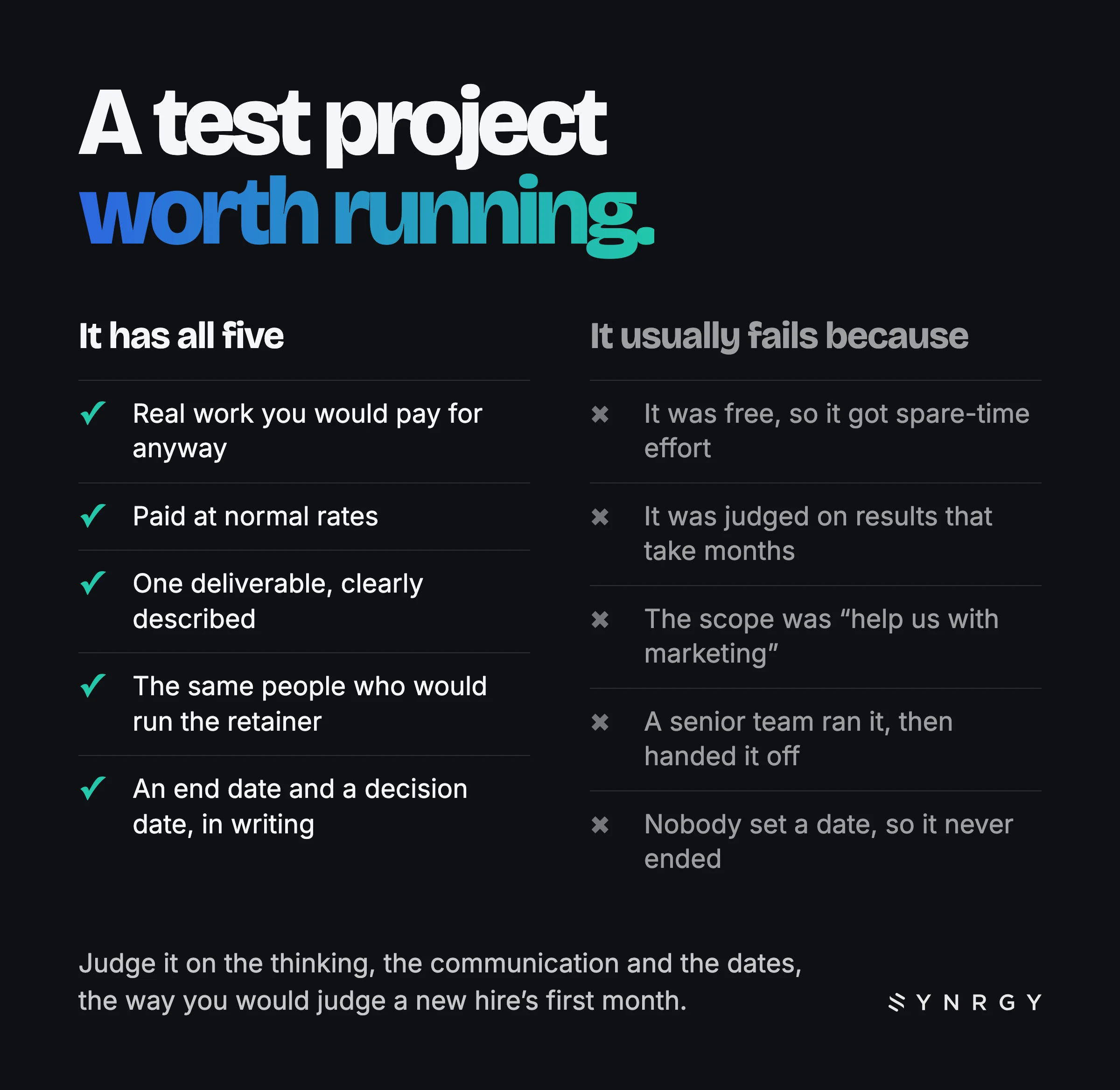
Make it real work. The test should be something you genuinely need and would pay for anyway. A made-up exercise produces made-up effort, and spec work for free is a way to find out who has the most spare time.
Pay normal rates. Agencies that do good work rarely do it for free, and the ones that will may give a free test less attention than paid work. Paying properly also means you can use the result.
Keep it small and specific. One deliverable, described clearly enough that both sides would agree whether it was finished. "Help us with marketing for a month" is not a test. "Rebuild our main Google Ads campaign and report on what changed" is.
Use the same people. Ask who would run the retainer, and make sure those are the people doing the test. A test staffed by the senior team followed by a retainer handed to someone else tests nothing.
Agree on a date and a decision. Write down when the test ends, what you will judge it on, and when you will decide. Without a decision date, a test project quietly becomes a retainer nobody chose.
Good test projects by service
Paid ads. An audit of your current account plus the rebuild of one campaign. You see how they diagnose problems and how clearly they explain what they changed.
SEO. A technical audit with the fixes made on your most important pages, plus a written plan for the next quarter. The plan shows how they think about priorities, which is what you are really buying.
Content. A month of content in your voice, from brief to published. You find out whether they can write like your business or only like an agency.
Email. One automated flow, such as a welcome sequence, written, built and launched. It is small, it has a clear finish, and it starts working as soon as it launches.
Brand and positioning. A discovery phase that ends in a written positioning statement. It is often the first step of a bigger project anyway, and it tells you whether they understand the business before anyone opens a design file.
Judge a test project the way you would judge a new hire's first month. Results come later. What you can see now is how they think, how they communicate and whether they do what they said.
What to judge it on
Because results take longer than the test, judge the things a test can actually show.
Did they ask good questions before starting? The best agencies spend the first days learning, and the questions they ask tell you how well they understand your business.
Did they deliver what they said, when they said? Small slips in a test project become large ones in a retainer.
Was the reporting clear? At the end you should understand what was done, why, and what they would do next, in plain language.
How did they handle disagreement? If you pushed back on something, did they explain their reasoning, adjust sensibly, or simply give in? You want an agency that will tell you when you are wrong.
Would you be glad to hear from them every week? This one is subjective and it matters. A retainer is a long conversation.
Retainer, project or advisor
Sometimes the test project reveals that a retainer is the wrong shape altogether.
If you mainly need direction and your own team can do the work, a strategic advisor, someone paid to review plans and steer decisions without executing them, may fit better than an agency. If the work turns out to have a clear end, a project may be better than either. Retainer or project covers how to tell which shape fits.
The same goes for agency-of-record arrangements, where one agency handles all of your work on an ongoing basis. They can work well, but they are the biggest commitment of all, which makes a test project even more valuable before signing one.
What to do next
Before you ask an agency for a test project, write down three things: the specific deliverable, the date it ends, and the questions you will use to judge it. Then ask the agency what they would change about your test. A good agency will improve it.
If you are still choosing between agencies, the questions that separate strong agencies from average ones and how to choose a branding agency cover that stage. Once you sign, a marketing plan that actually gets followed covers how to keep the work aimed at the right priorities.
You can also see how we approach marketing strategy.
Frequently asked questions
Should I run a paid test project before signing an agency retainer? Usually yes, if the retainer is for ongoing work such as SEO, paid media, content or email. A small paid project with a defined deliverable and an end date shows you how an agency works far better than a pitch does.
Should a test project with an agency be free? No. Pay normal rates. Free work tends to get less attention than paid work, and paying properly means you own and can use what the test produces.
How long should an agency test project be? Long enough to produce one real deliverable, and no longer. For most services that is a few weeks. Agree on the end date and the decision date before it starts.
What should I judge a test project on? Judge the questions they asked, whether they delivered on time, how clearly they reported, and how they handled disagreement. Long-term results such as rankings take longer than a test, so judging on them is unfair to every agency.
Is a test project worth it for a branding or website project? Usually not. Those are already projects with a natural end, so the project itself is the test. Splitting it into a trial phase tends to add a gap without adding information.
What is the difference between an agency retainer and a strategic advisor? An agency retainer pays a team to do ongoing work. A strategic advisor is paid to review plans and steer decisions while your own team does the work. If you mainly need direction rather than execution, an advisor may fit better.

Written By
Nick Kvistad
Principal Strategist
Put This to Work
Reading about it is free. So is finding out what it would take for your business.
Tell us what you are building and we will tell you honestly what it needs, whether or not you hire us. 85% of our business comes from referrals, because the advice is worth passing on.