How Much Content Do You Actually Need to Rank?
Volume is the wrong question. Coverage of a topic beats quantity of posts, and one good page can outrank thirty thin ones.
In short
Volume is the wrong measure. Coverage is the right one. A site with fifteen pages that genuinely answer everything a buyer needs will outrank a site with two hundred thin posts, and it will do it with a fraction of the work.
The question worth asking is not "how many posts" but "have I covered this topic completely enough that somebody could make a decision without leaving". That is what search engines are approximating, and it is what readers actually want.
Why volume stopped working
Publishing frequently was a legitimate strategy when there was less competition and ranking signals were cruder. It has not been for some time.
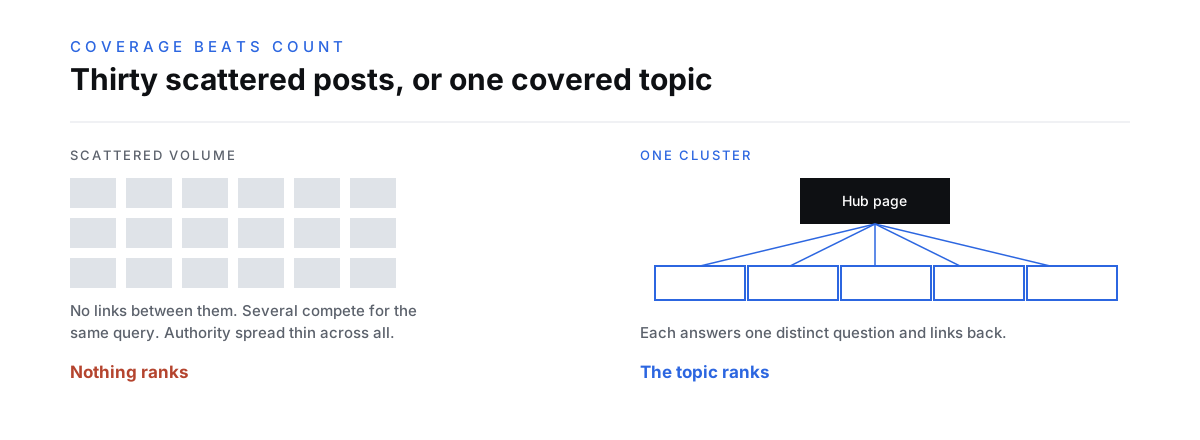
Search engines now evaluate whether a page satisfies the person who searched, and thin pages fail that test regardless of how many of them exist. Worse, publishing large numbers of weak pages actively harms you: it dilutes the authority passing around your site, and it creates internal competition where several of your own pages target the same query and none of them wins.
The arrival of AI-generated content has sharpened this further. Producing volume is now nearly free, which means volume no longer signals anything. What is scarce is genuine expertise, original data, and specificity that only comes from doing the work.
Think in clusters, not posts
The useful unit is a topic, not an article.
Pick a subject you genuinely want to be known for. Build one substantial page that covers it broadly, then a set of pages beneath it that go deep on the specific questions people actually ask. Link them together, with each specific page pointing back to the main one.
This does several things at once. It gives you a sensible internal linking structure. It stops your pages competing with each other, since each targets a distinct question. And it produces the thing search engines are looking for: evidence that you have covered a subject properly rather than touched it once.
A cluster of one hub and six to ten supporting pages is usually enough to compete on a topic, assuming the pages are genuinely good. That is a realistic quarter of work rather than a two-year content marathon.
6 to 10
Supporting pages around one hub. Enough to own a topic, if each page genuinely answers something
What counts as a page worth publishing
Four tests, and a page should pass all of them.
It answers a question somebody actually asks. Not a topic you find interesting, a question people type. If you cannot imagine the search that leads here, nobody will make it.
It answers completely. Somebody should finish it without needing another source for the same question. Partial answers get bounced back to the results page, and that is a signal.
It contains something only you could write. An original figure, a specific process, an opinion informed by having done the work. Content assembled from what already ranks adds nothing and will not outrank its own sources.
It is genuinely better than what currently ranks. Open the top three results and be honest about whether yours is more useful. If it is not, publishing it is filing rather than competing.
Most content plans fail the third and fourth tests. That is usually why they underperform, not because there was not enough of it.
One page that fully answers a question beats ten that partially answer it, and costs less to produce. Publishing cadence is a vanity metric.
The number nobody wants to hear
For a competitive commercial term, expect a hub plus six to ten strong supporting pages, and expect them to take three to six months to mature.
For a specific long-tail question with little competition, a single genuinely good page can rank within weeks.
The gap between those two is where most disappointment lives. Businesses target the competitive term, publish four posts, and conclude that content does not work. Content did not fail. The plan targeted the hardest available query with the smallest possible commitment.
Starting with the specific questions is more effective and considerably more encouraging. They rank sooner, they attract people with clearer intent, and they build the topical coverage that eventually makes the competitive term reachable.
Update before you publish more
The most reliable content win available to most sites is not a new page. It is fixing an existing one.
Pages that rank on the second page of results are close. They already have some authority and relevance, and moving them up is usually a matter of making them genuinely more complete rather than starting from nothing. Look for pages getting impressions but few clicks and improve those first.
Search Console will show you which. It is the highest-return hour in most content programs, and it requires no new writing brief, no new brief approval, and no waiting for a new page to be discovered.
Consolidation matters too. If you have three thin posts on nearly the same subject, combining them into one strong page and redirecting the others usually outperforms all three.
The pace you can actually hold
Cadence matters less than most content calendars assume, but abandonment matters enormously.
The common failure is not publishing too slowly. It is committing to three posts a week, sustaining it for a month, and then stopping entirely. A site that published heavily and then went quiet eighteen months ago signals neglect, and the archive of thin posts produced during the sprint is still there diluting everything.
One genuinely good page two weeks, sustained for a year, produces twenty-six pages worth having. Three thin posts a week for six weeks produces eighteen pages worth deleting and a habit that has already collapsed.
Set the pace at whatever you can hold during your busiest month, not your quietest. The whole strategy depends on still being there in a year, because that is roughly when the compounding starts to show.
What to do first
Pick one topic. Not five.
Write the hub page properly, then list every question a buyer asks about that subject and write the best available answer to each. Publish them steadily rather than all at once, link them together, and leave it alone long enough to work.
When that cluster ranks, do the next topic. This is slower than a content calendar promising three posts a week and it is the approach that actually compounds.
For how long the results take, how long does SEO take to work sets out the timeline. For where content sits in a budget, what does SEO cost per month covers it, and how to get cited by ChatGPT and Google AI Overviews covers what makes content quotable by AI surfaces. Our approach is described under content creation.
What to do next
Open Search Console, sort by impressions, and find the pages getting seen but not clicked.
Improving those is faster and more certain than writing anything new, and it will tell you more about what your audience actually searches for than any keyword tool.
Frequently asked questions
How many blog posts do I need to rank? There is no fixed number, but a hub page plus six to ten strong supporting pages is usually enough to compete on a topic. Coverage of the subject matters far more than the count of posts.
Is it better to publish more content or improve existing content? Improving existing content is usually the better return, particularly for pages already ranking on page two. They have authority and relevance already, so completing them often moves them up faster than a new page can rank at all.
How long should a blog post be? Long enough to answer the question completely and no longer. Word count is not a ranking factor, but thorough answers tend to be longer because thoroughness takes words. Padding to hit a target actively hurts.
Does publishing more often help SEO? Not by itself. Frequency signals nothing if the pages are thin, and large numbers of weak pages dilute site authority and create internal competition for the same queries.
What is a topic cluster? A hub page covering a subject broadly, plus supporting pages answering specific questions within it, all linked together. It prevents your own pages competing and demonstrates thorough coverage of the topic.
Should I delete old blog posts that do not rank? Consider consolidating rather than deleting. Combining several thin posts on similar subjects into one strong page and redirecting the old URLs usually outperforms keeping them separate or removing them outright.

Written by
Nick Kvistad
Principal Strategist
Put this to work
Reading about it is free. So is finding out what it would take for your business.
Tell us what you are building and we will tell you honestly what it needs, whether or not you hire us. 85% of our business comes from referrals, because the advice is worth passing on.