How to Build a Marketing Plan That Actually Gets Followed
Most marketing plans fail because they are too big, not because they are wrong. The fix is fewer things and named owners.
In short
Most marketing plans are abandoned by March, and almost never because the strategy was wrong. They fail because they were too big to survive a busy month.
A plan that gets followed has three properties: few enough priorities that they fit around real work, a named owner for every item, and a review rhythm that catches drift before it becomes abandonment.
The document is the least important part. The habits around it decide whether anything happens.
Pick three things, not twelve
The most common planning error is treating the plan as a wish list.
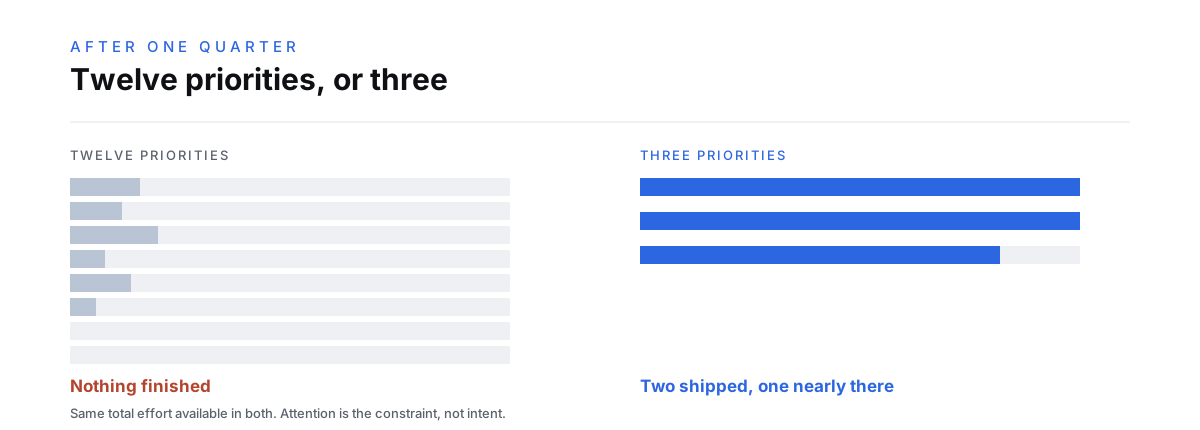
Twelve initiatives across six channels looks thorough and reads as ambitious. In practice it guarantees that everything progresses slightly and nothing finishes, because each item competes for the same limited attention. By month three the plan is visibly behind, and a plan that is visibly behind gets quietly ignored.
Three priorities for a quarter is realistic for most small businesses. If that feels thin, notice that three finished things beat twelve half-started ones, and that the plan currently in your drawer probably delivered fewer than three.
Choose by asking which bottleneck is costing you most right now: not being found, not being believed, not converting, or not retaining. Fix in that order.
Every item needs an owner and a date
An initiative without a name attached belongs to nobody, and nobody is reliably too busy.
"Improve the website" is not a task. "Rewrite the services page, owned by Sam, drafted by the 14th" is. The difference is not bureaucratic pedantry; it is the difference between something that can be checked and something that can only be felt guilty about.
Dates should be for the next step rather than the finished outcome. Large items with distant deadlines get deferred until they are late. The same item split into a first draft this month and a review next month tends to move.
If one person owns everything, which is common in a small business, the plan has to be small enough for that person's actual capacity. Writing a plan for a marketing team you do not have is the most reliable way to produce nothing.
Write down what you will not do
The most useful page in a marketing plan is often the list of things you are deliberately skipping this quarter.
Without it, every new idea arrives with equal weight, and the plan erodes through addition rather than disagreement. Nobody ever rejects the plan. They just add one more thing to it, repeatedly, until it is unrecognizable.
An explicit exclusion list makes that visible. When somebody proposes a new channel, the question becomes which of the three priorities it replaces. That is a real conversation. "Can we also do this" is not.
3 per quarter
The number of priorities most small businesses can actually finish. Twelve is a wish list wearing a plan's clothes
Set a review rhythm before you need it
Plans do not fail suddenly. They drift, and drift is only visible if somebody looks.
A monthly review of about half an hour is enough. What moved, what did not, what is blocked, and does the plan still reflect reality. The most valuable output is usually the decision to drop something rather than carry it forward guiltily.
A quarterly reset is where priorities genuinely change. Finish what worked, kill what did not, and choose the next three.
Put both in the calendar as recurring commitments before the quarter starts. A review that has to be scheduled each time is a review that stops happening in the third month, which is precisely when it starts mattering.
A plan is a set of decisions about what you will not do. Without that half, it is a list of hopes with dates attached.
Decide how you will know it worked
Every priority needs a measure agreed in advance, because measures chosen afterwards are chosen to flatter.
Be specific and modest. "More traffic" is unfalsifiable. "Organic sessions to the services pages up by a quarter by the end of the quarter" can be checked, and can be wrong, which is what makes it useful.
Pick measures close to the work. If the priority is publishing content, the leading measure is pages published on schedule, because that is within your control. Rankings and traffic follow later and depend on things you do not control. Judging early work on lagging measures makes it look like failure when it is simply early.
Accept that some things resist measurement. That is not a reason to avoid them, and how to measure marketing when you cannot track everything covers how to handle it honestly.
Keep it to one page
The length of a plan is inversely related to the likelihood of it being read.
One page: the three priorities, the owner and next date for each, the measure for each, and the list of what you are not doing. Everything else is supporting material that lives elsewhere and gets consulted when needed.
A forty-page document is a project in itself. It absorbs the energy that should have gone into the work, and produces the pleasant feeling of having done something. The plans that get followed are the ones somebody can hold in their head.
Plan for the quarter, not the year
Annual marketing plans are mostly a ritual. Twelve months is longer than most small businesses can forecast with any accuracy, and a plan built on assumptions that expire in March spends the rest of the year being quietly wrong.
Keep the annual view to direction rather than detail: what you want to be known for, roughly where growth should come from, and any fixed commitments like a launch or a seasonal peak. That is a page, and it changes rarely.
Then plan properly a quarter at a time. Thirteen weeks is long enough to finish something meaningful and short enough that your assumptions are still valid at the end of it. It also means four honest resets a year instead of one increasingly awkward annual review.
The businesses that execute well are rarely the ones with the most thorough annual document. They are the ones that decided three things in January, finished them by March, and then decided three more.
What usually goes wrong
The plan assumes a quiet quarter. Every quarter has an emergency. Build the plan for a normal busy month, not an idealized one.
Nobody owns it overall. Individual items have owners but nobody is responsible for the plan itself, so the review never happens.
It never changes. A plan that survives a quarter untouched has probably been ignored rather than followed. Adjusting it in the monthly review is a sign it is alive.
It starts with tactics. Choosing channels before identifying the bottleneck produces activity aimed at nothing in particular.
For how to size the budget behind the plan, marketing budget benchmarks covers what to spend. For choosing how to resource it, retainer or project works through the models. Our approach is described under marketing strategy.
What to do next
Take whatever plan you currently have and cut it to three priorities for this quarter.
Put a name and a next date against each, write down the four things you are consciously not doing, and book a thirty-minute review for the same day each month. That single page will outperform the document it replaced.
Frequently asked questions
Why do marketing plans fail? Usually because they are too large to survive a busy month, not because the strategy was wrong. Plans with a dozen initiatives progress everything slightly and finish nothing, which makes them easy to abandon.
How many priorities should a marketing plan have? Around three per quarter for most small businesses. Choose them by identifying your biggest bottleneck: not being found, not being believed, not converting, or not retaining.
How long should a marketing plan be? One page. Three priorities with owners, dates, and measures, plus a list of what you are deliberately not doing. Longer documents absorb the effort that should go into the work.
How often should I review my marketing plan? Monthly for about half an hour to catch drift, and quarterly to reset priorities. Book both as recurring commitments before the quarter starts, because reviews that need scheduling stop happening.
What should I measure? Pick measures close to the work and within your control, such as pages published on schedule, rather than only lagging outcomes like rankings. Agree them before starting, since measures chosen afterwards tend to flatter.
Should a small business hire an agency or do it in-house? It depends on which capability you are missing and for how long. Ongoing work usually suits a retainer or a hire, while defined pieces of work with a clear end suit a project engagement.

Written by
Nick Kvistad
Principal Strategist
Put this to work
Reading about it is free. So is finding out what it would take for your business.
Tell us what you are building and we will tell you honestly what it needs, whether or not you hire us. 85% of our business comes from referrals, because the advice is worth passing on.