How to Build a Quarterly Marketing Plan
A quarterly plan fits on one page: one goal, three priorities, an owner, a date and a budget for each, the measures you will use, and the reviews already on the calendar.
In short
A quarterly marketing plan fits on one page. It names one goal for the next thirteen weeks, the bottleneck standing in the way, and three priorities to work on. Each priority has an owner, a finish date and a budget. The plan lists how you will know it worked, and it puts the review meetings on the calendar before the quarter starts.
A quarter is the right length because it is long enough to finish something real and short enough that the plan is still true when you reach the end of it.
Build it in an afternoon, starting from what happened last quarter rather than from a blank page.
Why a quarter is the right length
An annual marketing plan is written in January for a business that will look different by June. By the second half of the year most annual plans are either quietly ignored or followed out of habit, after the reasons behind them have changed.
A monthly plan has the opposite problem. A month is too short to finish most marketing work. A new website section, a properly tested ad campaign or a set of articles that start to rank all take longer than four weeks, so a monthly plan ends up as a to-do list that rolls over.
Thirteen weeks sits in between. You can start and finish two or three meaningful pieces of work, see early results from them, and still change course before much is wasted. Keep the year for direction, meaning where the business is heading and roughly what you will spend, and use the quarter to decide what actually gets done.
What goes on the page
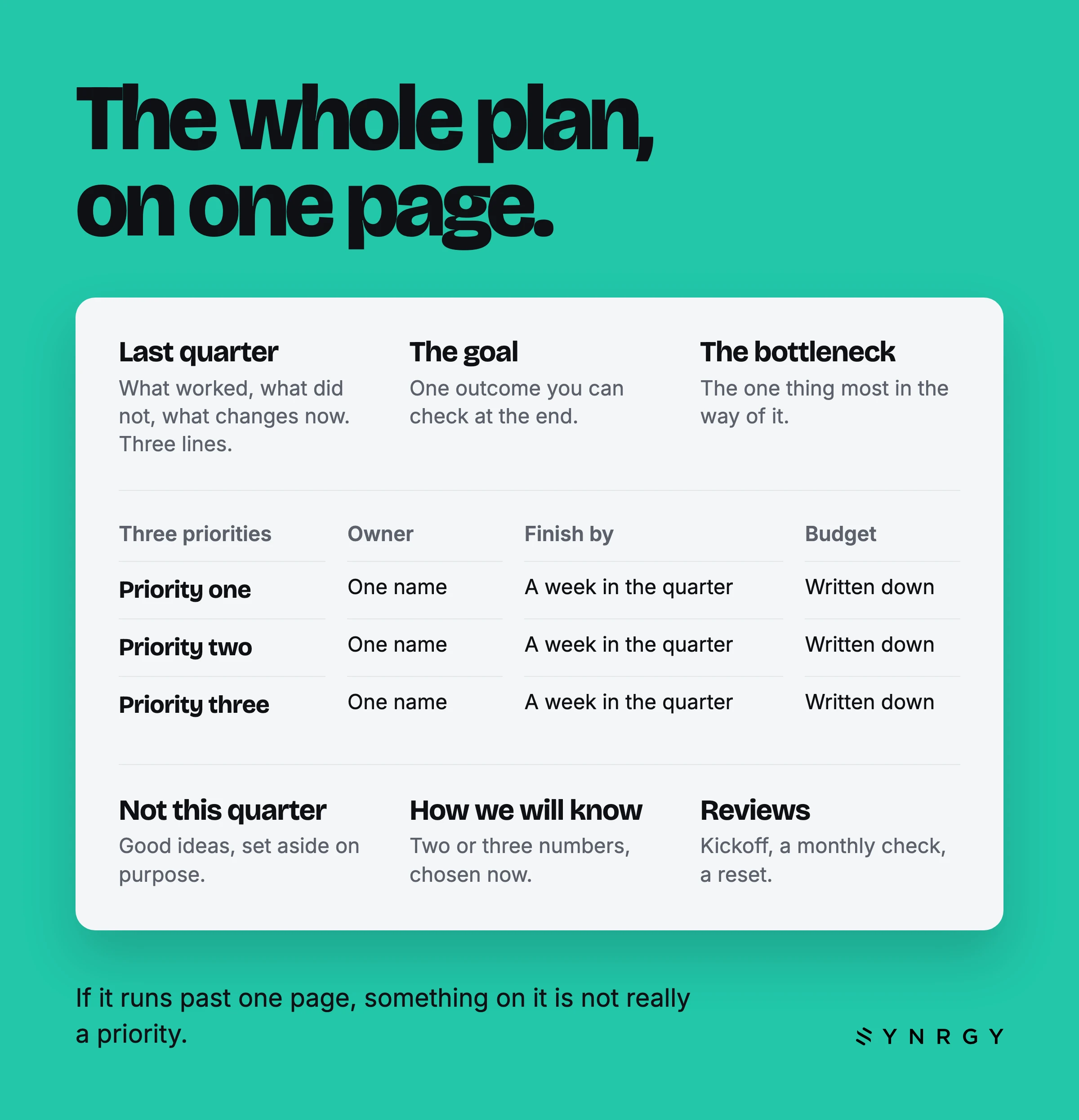
Eight things, in this order:
- Last quarter in three lines. What worked, what did not, and anything you learned that changes this quarter.
- The goal. One outcome for the quarter, written so you could tell at the end whether it happened.
- The bottleneck. The single thing most standing between the business and that goal.
- Three priorities. The pieces of work that attack the bottleneck.
- Owner, date and budget for each priority. One name, not a team.
- What you are not doing. The ideas you have deliberately set aside until next quarter.
- How you will measure it. The two or three numbers you will look at, decided before you start.
- Review dates. Already on the calendar.
That is the whole plan. If it runs past one page, something on it is not really a priority.
Step 1: Start from last quarter
Before you plan anything new, spend half an hour on what just happened. Which work moved a number you care about? Which work got done but changed nothing? What did you mean to do and never started, and why?
This step stops the most common planning mistake, which is writing a fresh list of ideas while the reasons last quarter's list stalled are still there. If last quarter's priorities never started because nobody had time, a new quarter with three more priorities and the same people will stall in the same place.
Step 2: Name one goal and the bottleneck
Pick one outcome for the quarter. It might be more booked calls, a higher close rate from the calls you already get, a new service that has paying customers by the end of the quarter, or a website that finally converts.
Then name the bottleneck: the single thing most in the way. If the phone rings but nobody buys, more traffic is not the bottleneck. If the website converts well but nobody visits it, conversion work is not the bottleneck. Getting this right matters more than anything else on the page, because every priority should push directly on it.
Step 3: Choose three priorities
Three is enough to make real progress and few enough to finish. Each one should be a piece of work with a clear end, such as "rewrite the three main service pages", "launch a Google Ads search campaign for our two best services", or "set up a welcome email sequence for new inquiries".
Avoid priorities that are really ongoing activities, such as "post on social media" or "do SEO". Activities belong in someone's weekly routine. A quarterly priority should be finished by the end of the quarter, so that the next plan can start from something new.
Step 4: Give each priority an owner, a date and a budget
One owner per priority. Shared ownership means no ownership. The owner does not have to do all the work, but they are the person who answers "where is this?" in the review.
A finish date inside the quarter. Leave the last two or three weeks of the quarter clear for slippage and for measuring results. A plan that finishes everything on the final day has no time to learn from what it did.
A budget. Even a small one, written down. Money that is not allocated at the start of the quarter tends to get spent on whatever is urgent in week nine.
Step 5: Decide the measures before you start
Pick two or three numbers that will tell you whether the goal happened, and write down where each one is read and what it is today. Booked calls, inquiries by source, conversion rate on a specific page, cost per lead from a specific campaign.
Deciding in advance matters because it is very easy to find a flattering number after the fact. If you cannot measure something perfectly, a consistent rough measure is still useful. How to measure marketing when you cannot track everything covers how to do that honestly.
Step 6: Put the reviews on the calendar
Schedule three kinds of review before the quarter starts.
A short kickoff in week one. Everyone with a priority confirms the date and the budget, and raises anything that already looks unrealistic.
A monthly check of about half an hour. What moved, what is stuck, and whether the plan still reflects reality. The most useful outcome is often a decision to drop or shrink something.
A reset at the end of the quarter. Finish what worked, stop what did not, record what you learned in three lines, and start the next plan from there.
A quarterly plan that survives thirteen weeks unchanged was probably never opened. Adjusting it in the monthly review is a sign it is being used.
What a quarter looks like in practice
Here is an illustrative example for a service business whose phone rings but whose website rarely produces inquiries. The details are made up to show the shape, not drawn from a real client.
Goal: more inquiries through the website form.
Bottleneck: visitors arrive but the service pages do not answer their questions, so they leave.
Priorities: rewrite the three main service pages around the questions customers ask on the phone, owned by the marketing lead and finished by week six; add a clear call booking step to every service page, owned by the web developer and finished by week four; set up a two-email follow-up for anyone who starts the form and does not finish, owned by the office manager and finished by week eight.
Not this quarter: a new logo, a podcast, a second location page.
Measures: website inquiries per month, form starts against form completions, and calls booked from the website.
Reviews: kickoff in week one, monthly checks, and a reset in the final week.
Everything on that page points at one bottleneck. That is what makes it likely to work.
How the quarterly plan fits the year
The year still matters. Decide roughly what you will spend on marketing across the year, what the business is trying to become, and which big pieces of work belong in which half. Marketing budget benchmarks can help with the spending side.
Then let the quarters do the work. Each quarterly plan should move the business toward the annual direction, but it is free to change how, based on what the last thirteen weeks taught you. If a quarter shows that the annual direction itself was wrong, change it. That is a better outcome than finishing a year of work on a plan nobody believes in.
What to do next
Block an afternoon before the quarter starts. Spend the first half hour on last quarter, then fill in the eight sections in order, and put the three review dates on the calendar before you close the document.
For the habits that keep a plan alive once it is written, see how to build a marketing plan that actually gets followed. If you are still deciding where to start, branding or marketing first may help you find the bottleneck.
If you would like help building yours, see how we approach marketing strategy.
Frequently asked questions
What should a quarterly marketing plan include? One goal, the bottleneck in the way of it, three priorities, an owner, a finish date and a budget for each priority, what you are not doing this quarter, the measures you will use, and the review dates. It should fit on one page.
How often should a marketing plan be reviewed? A short check once a month, of about half an hour, and a full reset at the end of each quarter. The monthly check is for adjusting the plan, and the quarterly reset is for choosing new priorities.
What is the difference between an annual and a quarterly marketing plan? The annual plan sets direction and the overall budget. The quarterly plan decides which specific pieces of work get done in the next thirteen weeks, who owns them and how you will measure them.
How many goals should a quarterly marketing plan have? One goal, supported by three priorities. More goals split attention, and in a quarter that usually means nothing finishes.
Who should own the quarterly marketing plan? One person should own the plan overall and run the reviews, and each priority should have its own single owner. A plan owned by a committee rarely gets reviewed.
Is a 90-day marketing plan the same as a quarterly plan? In practice, yes. Both cover about thirteen weeks. The useful part is the structure: one goal, a few finished priorities and reviews on the calendar. The exact number of days matters much less.

Written By
Nick Kvistad
Principal Strategist
Put This to Work
Reading about it is free. So is finding out what it would take for your business.
Tell us what you are building and we will tell you honestly what it needs, whether or not you hire us. 85% of our business comes from referrals, because the advice is worth passing on.